-3.svg)
The Crypto Marketing Agency Judged on Wallets, Not Impressions
Since 2019, LuvKaizen has run marketing for token launches, exchanges, L1s and Web3 apps across 200+ campaigns. Teams hire us when they need something countable to move: developer signups, testnet users, verified accounts, volume.
Quick answer: A crypto marketing agency plans and runs growth for token projects, exchanges and protocols across KOL campaigns, community management, PR, content and paid acquisition, measured on wallet connects, deposits and trading volume rather than impressions. LuvKaizen has delivered 200+ crypto campaigns since 2019 through a vetted network of 5,000+ crypto KOLs.
Three things separate an agency worth paying from a reseller of posts: it tells you what creators actually cost before you sign, it can show the mechanism tying a specific post to a specific wallet, and it knows which of MiCA, the UK financial promotion rules, FTC disclosure and platform ad certification apply before the first brief goes out. This page covers all three.
In practice that has looked like 5,000+ developer signups for io.finnet in three weeks, 12,000 testnet users for Saakuru Labs in six weeks, 32,000 users onboarded for Swissmoney with cost per acquisition cut 4x, full TGE execution for Step App, and $153M average monthly trading volume for Gate.io against a $100M target. Read this before you book anything, with us or with anyone else.
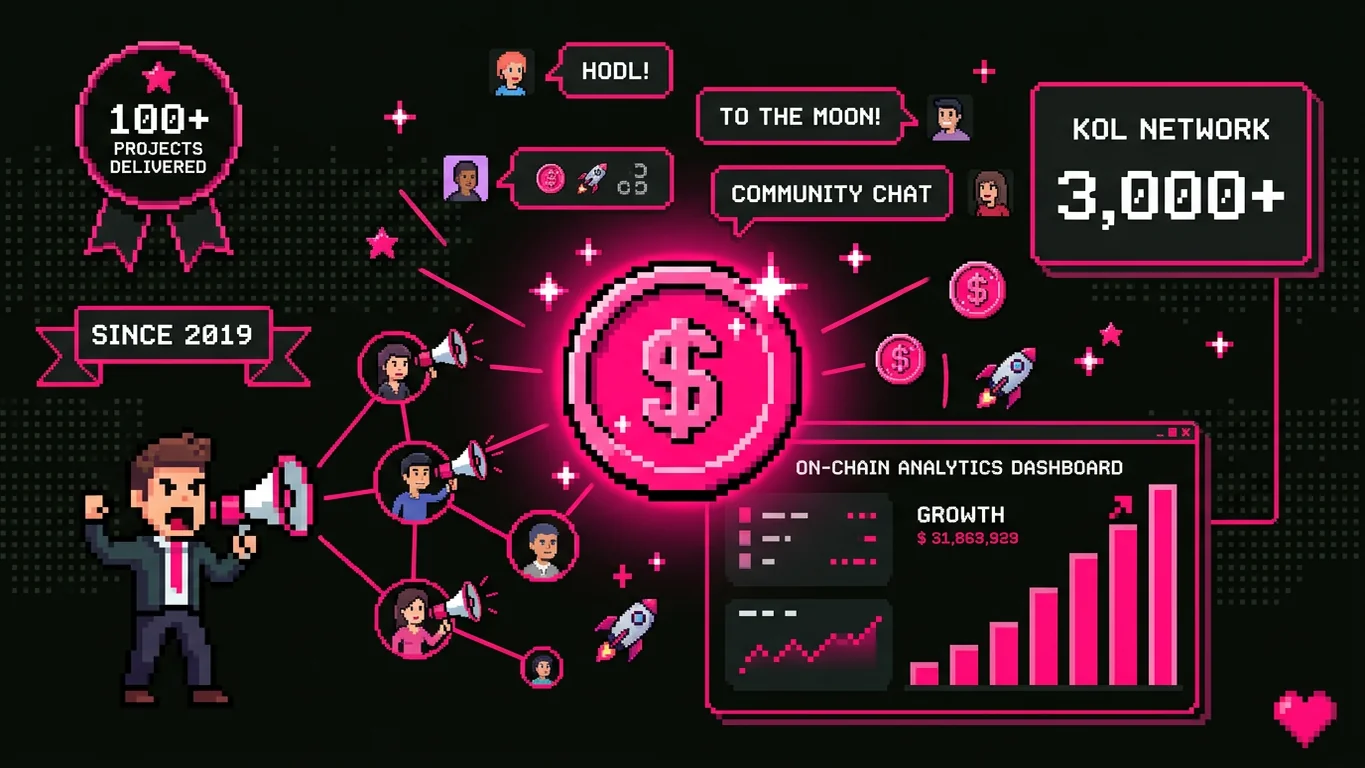
Trusted By Industry Leaders


Why Most Crypto Marketing Fails, And What We Do Instead
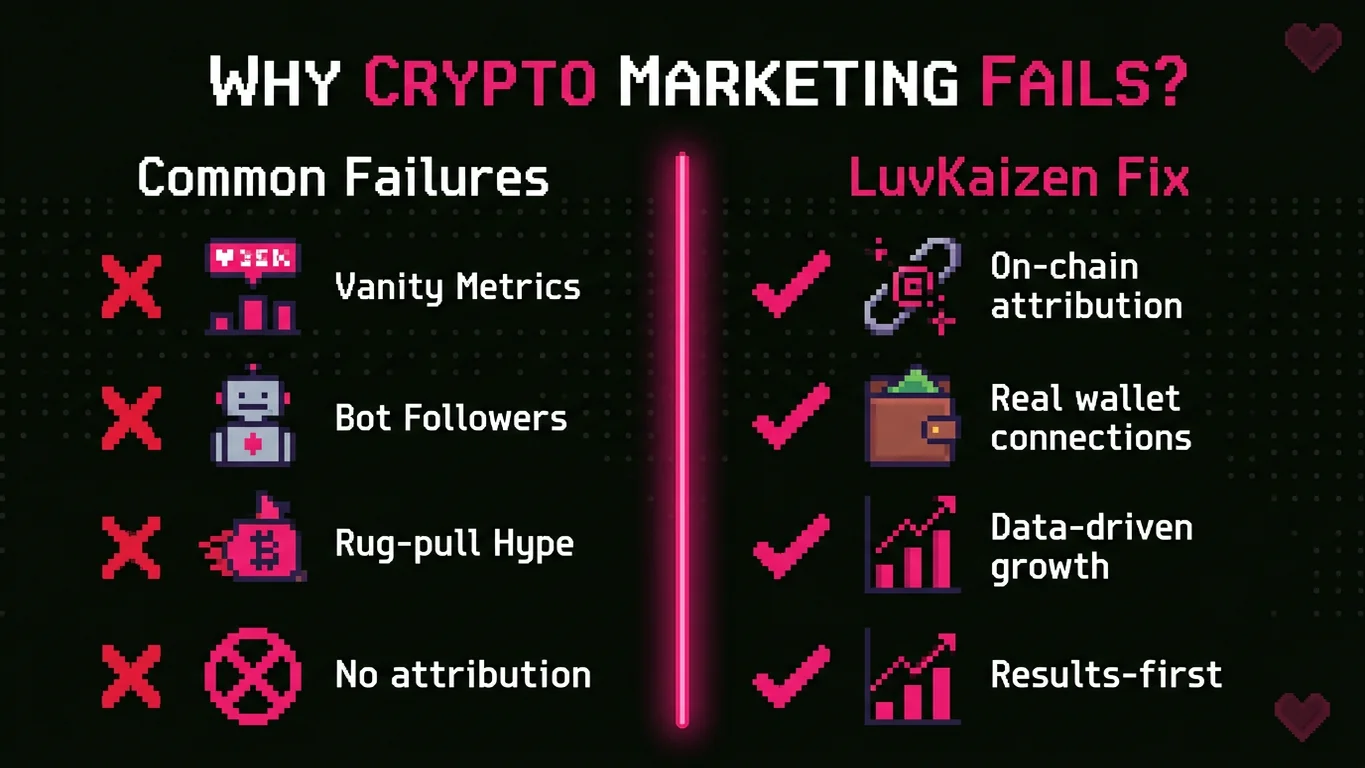
Most crypto marketing budgets are wasted in five predictable ways: paying for reach instead of intent, running with no attribution layer, leaning on a single channel, starting too late, and treating compliance as a legal problem discovered after the creative is booked. Each is avoidable, and each is visible in the first week of an audit.
The default playbook is still buy a batch of posts, spam a few Telegram groups, hope the chart moves. It stopped working because the audience changed. Buyers check the on-chain history behind a call, check whether a Discord is people or bots, and identify a paid thread in about two seconds.
What are the five failure modes we see most often?
- Paying for reach instead of intent. A 200,000-follower account full of airdrop farmers is worth less than a 12,000-follower account whose replies are people who deploy contracts. Reach is the cheapest thing to buy and the least correlated with outcomes.
- No attribution layer. If you cannot tie a signup, a wallet connect or a deposit back to the creator who caused it, you are optimizing blind and every renewal decision is a guess dressed up as a report. Tracking gets built before spend, not after the first invoice.
- One channel carrying everything. KOL posts create a spike. With no community, content or retargeting behind them, it decays inside 72 hours and you pay again for the next one. Three channels run as a loop beat six run in sequence.
- Starting too late. Teams arrive four weeks before TGE. Four weeks buys noise. It does not buy a community that holds through the first drawdown.
- Compliance discovered after the creative is booked. The newest failure mode and now one of the most expensive. A campaign designed for a global audience and then pointed at the EU or the UK gets rewritten, delayed or pulled. Jurisdiction and disclosure requirements belong in the brief, not in the post-mortem.
What do we do instead?
Our alternative is unglamorous. Pick a small number of metrics that map to the business. Build tracking before spend. Scope the regulatory perimeter before the creator list is signed. Run several channels as a loop rather than in sequence. Cut what underperforms in week two rather than month three. That discipline is how io.finnet reached 5,000+ developer signups in three weeks and Saakuru Labs 12,000 testnet users in six: not a bigger creator list, but per-creator data read early enough to move budget mid-campaign.
What We Deliver, And How A KOL Post Becomes A Tracked Wallet
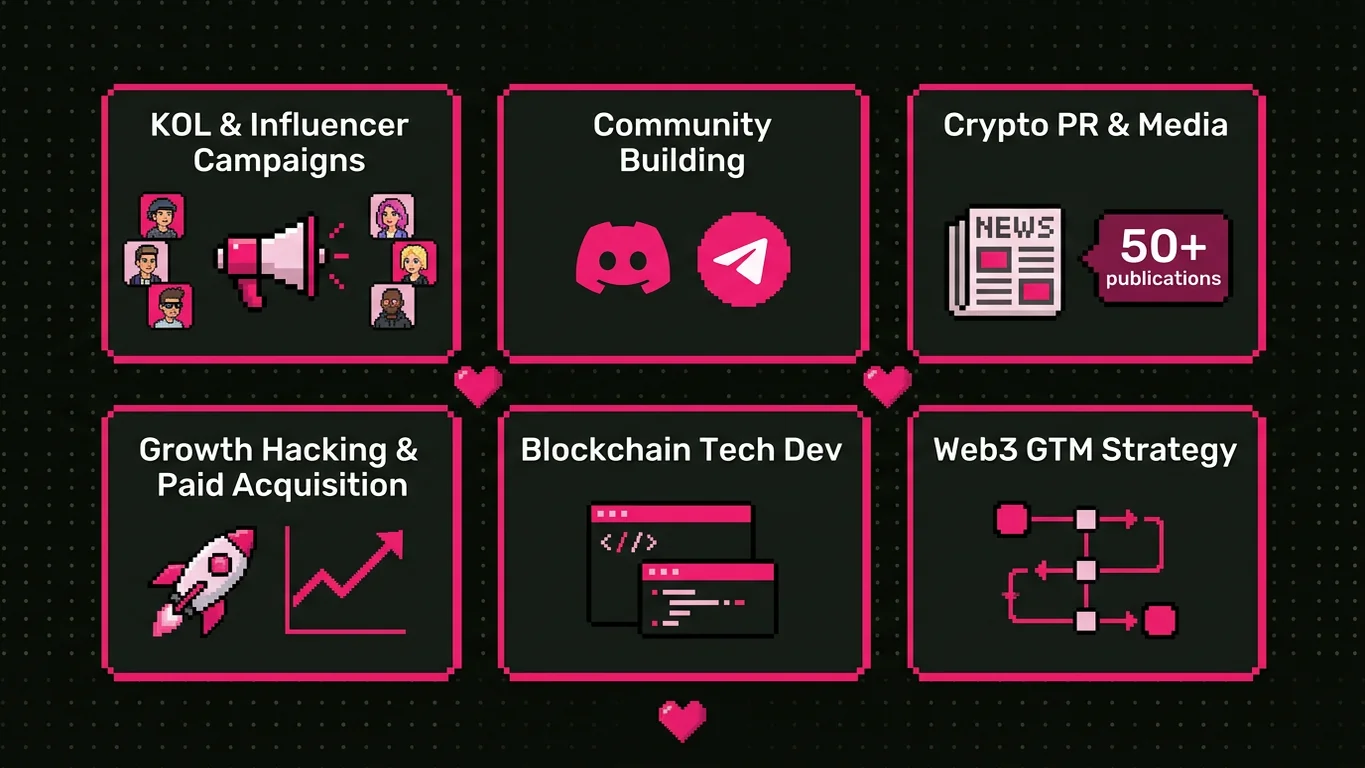
We deliver KOL and influencer campaigns, short-form video and clipping, community building, crypto PR, social content, and paid acquisition. All of them report into one attribution chain: creator, tracked link, landing event, wallet connect, on-chain action, cost per qualified action. If a channel cannot be tied to that chain, we do not sell it as performance work.
What does a crypto marketing agency actually deliver?
- KOL and influencer campaigns. 5,000+ vetted crypto creators across X, YouTube, TikTok and Telegram, 300+ exclusive to us, 3M+ combined followers. You get a shortlist with audience quality notes rather than a raw roster, negotiated rates, approved copy, scheduled posting, and a tracked link per creator. Mechanics on our crypto influencer marketing service page; operating model on our crypto KOL agency page.
- Short-form video and clipping. A dedicated UGC and clipping desk producing native vertical video for TikTok, Reels and Shorts, delivered as batches of hook-tested variants rather than one hero film, so you can kill whatever fails in the first three seconds. See our crypto clipping agency page.
- Community building and management. Discord, Telegram and X coverage: moderation rotas across time zones, onboarding flows, quest mechanics, weekly sentiment reporting, and escalation paths for FUD and exploit rumors before they set the narrative. We optimize for members still active in week four. Detail on our crypto community management page.
- Crypto PR and media. 50+ media partners across crypto and mainstream tech press. We quote per placement and label which outlets are paid and which are earned, because conflating the two is how projects pay editorial rates for advertorials. More on our cryptocurrency PR agency page.
- Search and AI visibility. Buyers research a token through both Google and an AI assistant. Technical and content work runs through our crypto SEO services; citation work through our crypto AEO agency practice.
- Launch programs. TGE, presale, mainnet and listing campaigns with a fixed date and sequence, on our token launch marketing page.
How does a KOL link become a tracked wallet connect?
Almost every crypto marketing agency claims this and almost none will describe it. Here is the chain we build in week three, before any creator posts.
- One tracked link per creator, per placement. Not one per campaign. Each placement gets its own short link carrying UTM parameters: source is the creator handle, medium the channel, campaign the program, content the format and date. A creator who posts three times has three links, so one strong thread does not get credit for two weak ones.
- A redirect layer that captures the click. The short link resolves through our redirect, which records a click ID, timestamp, referrer, country and device class, then forwards to your landing page with the click ID appended as a query parameter.
- A first-party stamp on landing. The click ID is written to first-party storage on your domain, so it survives navigation inside your app. Third-party cookies do not.
- The join at wallet connect. When a user connects a wallet, your app fires one event binding the stored click ID to the wallet address. That event is the join key. Everything downstream is a query, not a guess.
- On-chain cohorts. With addresses mapped to creators, on-chain events are read from an indexer or your own event stream and rolled back to the creator who produced them: first deposit, first swap, bridge, testnet transaction, stake, second-week return. The output is a cohort per creator, not a total per campaign.
What does the dashboard actually report?
| Stage | What is measured | Why it matters |
|---|---|---|
| Placement | Creator, format, date, negotiated fee | Every downstream number divides by a real cost |
| Click | Unique clicks per placement, country, device | Separates a big audience from an interested one |
| Landing | Sessions, bounce, time to first action | Catches a landing page killing a good campaign |
| Wallet connect | Connects, new versus returning addresses | The first genuinely qualified signal |
| Qualified action | Deposit, swap, testnet transaction, verified signup | The metric you agreed to be judged on |
| Retention | Cohort still active at day 7 and day 30 | Separates a farmer cohort from a user cohort |
| Unit economics | Cost per qualified action, by creator | Tells you where next month's budget goes |
What cannot be attributed honestly?
Plenty, and any agency that says otherwise is selling a model rather than a measurement. A KOL post screenshotted into a private Telegram group produces users with no link. Someone who sees a video, does nothing, and searches your brand two days later on another device arrives as organic. Privacy browsers strip parameters. A user can connect an address funded long before your campaign. Deep links into mobile wallet browsers break session continuity more often than anyone admits.
So we bound the claim. We report one model and label it: last non-direct click, seven-day window, deduplicated by address. Alongside it we run the checks that catch what the model misses: branded search lift against a pre-campaign baseline, a geographic or timing holdout where budget allows, an on-site "how did you hear about us" field used as triangulation rather than truth, and a plain statement of the share of qualified actions that arrived unattributed. Hiding that last number is how agencies manufacture ROI.
Impressions, follower growth and reach go in an appendix, not a headline. Views are an input, not a result. And we do not report a number we cannot reproduce from raw data on request.
What Crypto KOLs Actually Cost: The 2026 Rate Benchmark
Micro crypto KOLs charge roughly $200 to $500 per post, mid-tier KOLs run $1,000 to $5,000 per placement, and top-tier voices start at $10,000 and rise well into five figures for a dedicated YouTube review. Booked prices typically land 20 to 40 percent below public rate cards when negotiated at agency volume. These are the figures we book against, published here because almost no crypto marketing agency publishes them at all.
This matters more than the agency fee. On KOL work, creator fees are the majority of the budget and the management fee is the small line. Compare two agencies on monthly fee alone and you are comparing the wrong number; the one quoting a lower fee while marking up creator rates costs you more.
What do crypto KOLs charge by tier?
| Tier | Typical rate per post | What you are buying | Best used for |
|---|---|---|---|
| Micro KOL | $200 – $500 | Small but genuinely engaged niche audience | Often the best cost per engaged viewer in crypto; volume testing across several narratives |
| Mid-tier KOL | $1,000 – $5,000 | Established authority inside a specific niche | The workhorse of most winning campaigns; sustained conversion rather than a single spike |
| Top-tier KOL | $10,000+ | Major X accounts and large YouTube channels | Launch-window credibility and reach; flagship dedicated videos reach well into five figures |
What moves the price is not follower count. It is engagement quality, niche fit, format, and demand on that creator's calendar. A mid-tier KOL whose audience is entirely DeFi-native routinely outperforms a general-crypto account with ten times the followers, at a fraction of the cost.
How do format and platform change the price?
Format changes price more than platform does. On X, a single post costs less than a thread, and a pinned placement carries a premium. Telegram channel posts price similarly to X, with AMAs quoted separately. TikTok clips sit in the accessible range. YouTube is the premium end: an integration inside an existing video costs a fraction of a dedicated review, and the dedicated review is the single most expensive KOL format in crypto.
Non-English markets, in particular Chinese, Korean, Vietnamese and Turkish, often deliver stronger rates relative to audience quality, which is why multi-market campaigns stretch a budget further than the same money spent entirely in English.
What should a first crypto KOL campaign budget be?
A meaningful first test usually means 8 to 15 placements spread across tiers, enough volume to read what converts rather than what got lucky. Most pilots land in the $10,000 to $30,000 range. Launch-scale pushes around a TGE or exchange listing run higher, because they stack top-tier voices and several language markets into a short window. To build the number, decide the qualified action, set a tolerable cost per action, and work backwards through the funnel stages in the attribution table above. Any agency unwilling to show the fee-versus-creator-cost split is hiding a markup.
Why do quoted prices differ so much from rate cards?
Public rate cards are opening offers, not prices. Real booked rates move with volume, timing and relationship, which is why agency-volume bookings typically land 20 to 40 percent below card. The bigger trap is not overpaying a rate card; it is paying anything at all for botted reach. An account with inflated followers turns even a cheap post into the most expensive line in your budget. Every KOL we book has passed audience-authenticity and engagement-quality checks, and underperformers are delisted.
For the full breakdown by tier, platform and format, including token-based KOL rounds and vesting, see our crypto KOL cost guide.
Crypto Marketing Compliance in 2026: MiCA, the FCA, Disclosure and Ad Platforms
Four regimes decide what a crypto campaign may say in 2026: MiCA in the EU, the FCA financial promotion rules in the UK, FTC and ASA disclosure requirements on paid creator content, and the advertiser certification programs run by Google, Meta and X. None are optional, all bind the marketing rather than just the legal entity, and most crypto marketing agencies do not mention them at all. Scoping them is the first thing we do, not the last.
This is operational marketing compliance, not legal advice: we build campaigns that fit the rules alongside your counsel, and route licensing questions to vetted legal partners.
What does MiCA require of crypto marketing in the EU?
Under Article 7 of the Markets in Crypto-Assets Regulation, marketing communications for a public offer or admission to trading must be clearly identifiable as marketing, fair, clear and not misleading, and consistent with the crypto-asset white paper. They cannot circulate before the white paper is published where one is required, and must carry the prescribed statement that the communication has not been reviewed or approved by any competent authority in any EU member state and that the offeror is solely responsible for its content.
Practically: the claim in a KOL brief has to match the white paper, the disclaimer has to survive the platform's character limits, communications must be published on the offeror's website and made available to competent authorities on request, and material changes require the marketing to be updated rather than left live.
What do the UK financial promotion rules mean for a KOL post?
The UK regime is the strictest of the four, and it is criminal law rather than a code of practice. Since October 2023, communicating a cryptoasset financial promotion to UK consumers has been lawful only through four routes: the communicator is FCA-authorized, the promotion is approved by an authorized firm holding the relevant permission, the firm is registered under the Money Laundering Regulations and promotes its own cryptoassets, or a Financial Promotion Order exemption applies. Breaching the restriction is an offense under the Financial Services and Markets Act 2000.
The content rules follow high-risk investment standards: a prescribed risk warning, a ban on incentives to invest such as refer-a-friend schemes and new-joiner bonuses, client categorization and an appropriateness assessment, a personalized risk warning, and a 24-hour cooling-off period for consumers new to that firm. FCA guidance FG24/1 extends this to creator content and makes clear influencers themselves can be liable for an unlawful promotion. That changes who you can book, what they may say, and whether UK traffic should be geo-excluded at all.
How must paid creator content be disclosed?
In the US, the FTC Endorsement Guides require any material connection between a brand and an endorser to be disclosed clearly and conspicuously, inside the endorsement itself. A platform's paid-partnership toggle alone is not sufficient, a disclosure buried in a hashtag block is not conspicuous, and responsibility is shared between advertiser, agency and creator. Payment in tokens is a material connection exactly as cash is, as is a discounted allocation with vesting.
In the UK, the CAP Code requires advertising to be obviously identifiable as such, meaning a prominent #ad at the start of a caption rather than the end. The ASA has repeatedly ruled against crypto advertising that trivialized risk or failed to make clear that cryptoassets are unregulated in the UK and capital is at risk. Our standard: disclosure is written into the brief, checked before the post goes live, and archived with every placement.
Which ad platforms will actually run crypto creative?
- Google Ads. Exchanges, software and hardware wallets, and US coin trusts require advertiser certification, targetable only at an approved country list, with separate applications per country. Prohibited outright: ICOs and token presales, DeFi trading protocols and liquidity pools, unhosted software wallets, and trading signals or investment advice. From June 2026, certification applications are submitted inside the Google Ads account rather than the Help Center.
- Meta. Written permission is required for exchanges, trading platforms, wallets with buy or trade functionality, lending platforms and mining services. Storage-only wallets and educational content sit in an easier lane.
- X. Advertisers must satisfy local licensing requirements. ICOs, IEOs and IDOs are banned, mining hardware and software promotion is banned, and several jurisdictions are excluded entirely.
The planning consequence: paid media almost never carries a token launch on its own. It supports a campaign whose weight sits in creator content, community and earned media, and needs a licensed entity and compliant landing page behind it.
How is an engagement structured week by week?
| Phase | Timing | What happens | What you receive |
|---|---|---|---|
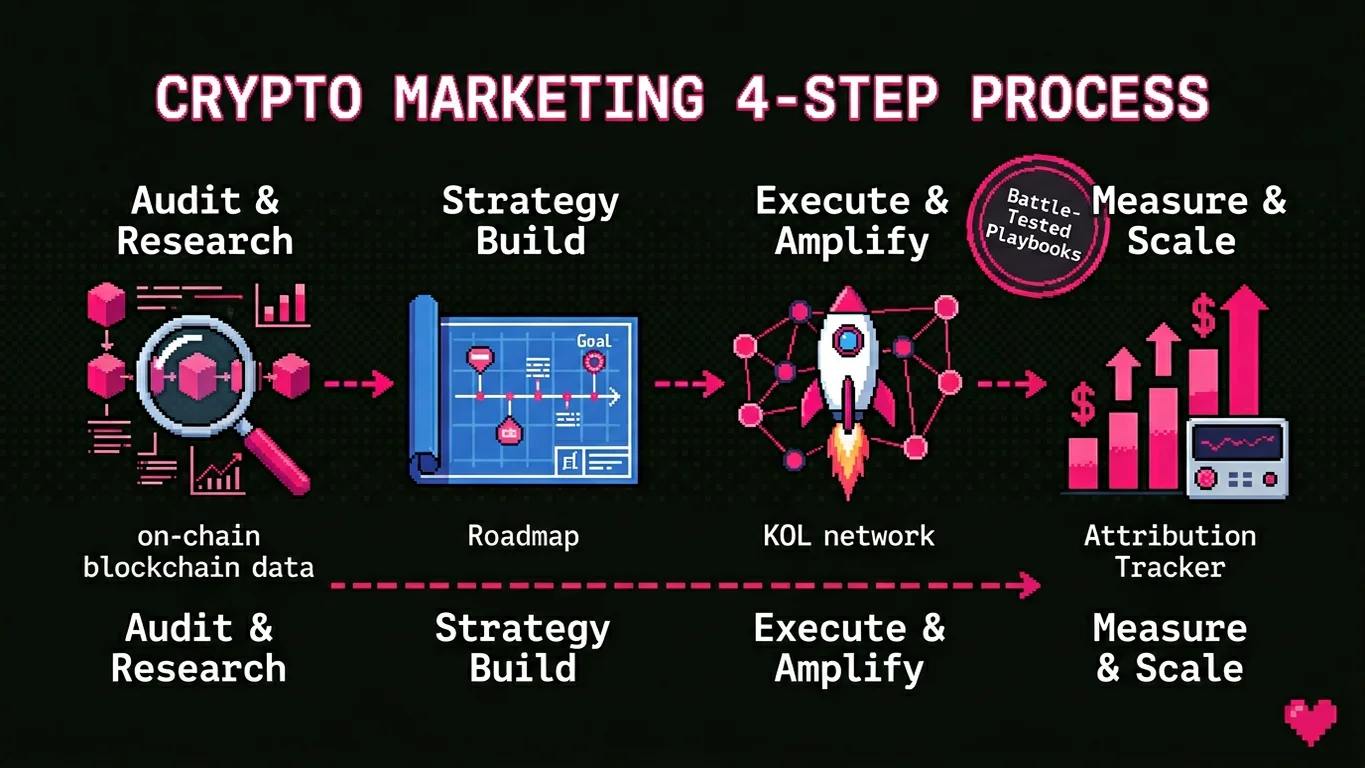
| Audit and jurisdiction scope | Days 1–7 | Tokenomics, competitor and community review, analytics access, baselines, regulatory perimeter agreed: which markets, which regimes, what gets geo-excluded | Audit with baselines, the three metrics we agree to be judged on, a compliance note per market |
| Strategy and shortlist | Days 8–14 | Channel plan for your stage, creator shortlist with audience quality notes, budget split between media and production | Written plan, named creator list with rates, campaign calendar |
| Build and brief | Days 15–21 | Tracked links, redirect layer and dashboard live; briefs written with disclosure and risk-warning language built in | Approved creative, working attribution, staffed community |
| Launch | Days 22–45 | Phased creator activation, content cadence, community events, first paid tests | Weekly performance call, always-on dashboard |
| Read and reallocate | Day 45 onward | Underperformers dropped, budget moved to what converted | Monthly review with explicit keep or cut decisions |
How do you bill?
| Model | Best for | How it is billed | Commitment |
|---|---|---|---|
| Single-service retainer | In-house teams filling one gap: KOLs, PR, community or UGC | Monthly management fee; creator and media costs at cost | Month to month |
| Multi-channel retainer | Projects with no in-house team, needing the full stack | Monthly fee scaled to channels; media budget held separately | Month to month |
| Launch sprint | TGE, exchange listing, mainnet or testnet with a fixed date | Fixed scope, usually six to twelve weeks | Fixed term |
| Volume UGC and clipping | Continuous short-form where cost per asset matters most | Priced per batch of delivered assets | Rolling |
Cadence and approvals. One weekly call, a shared dashboard, a monthly written review. Your point of contact is the person running the campaign, not an account manager. You approve the creator list and every piece of copy naming your project before it goes live, and no creator is paid before their post is verified live and correctly disclosed.
What we need. Analytics access in week one, the ability to fire one event at wallet connect, one decision-maker who can approve inside 48 hours, and honesty about the launch date. Slipping timelines are survivable; discovering them in week three is not.
How To Evaluate Any Crypto Marketing Agency, Including Ours
Run these six questions on every agency on your shortlist, including us, and ask for answers in writing rather than on a call. An agency that answers all six specifically is worth a pilot. One that answers in adjectives is worth a pass, regardless of the logos on its homepage.
What six questions should you ask before signing?
- Name three creators you would use and explain why. Talking about a network of thousands is easy. Naming three accounts and defending the audience fit for your project is not.
- How will you attribute a signup or deposit to a specific post? Ask them to describe the chain: link, landing, wallet connect, on-chain event. If the answer stops at "we send a weekly report," there is no attribution.
- What is your fee versus pass-through media spend? Agencies that will not separate the two are usually marking up creator fees. Ask for the split in writing and check it against published benchmarks.
- Which regimes apply here, and who owns compliance? If your users include the EU or the UK and the answer is a blank look, the campaign gets rewritten later at your expense.
- Who is doing the work day to day? Ask for the names on your account, not the founder who takes the sales call.
- What would make you tell me not to run this, and show me one that failed. An agency that has never turned work away will take yours regardless of whether it can help.
What are the red flags?
- Guaranteed token price, guaranteed exchange listings or guaranteed editorial coverage. None can honestly be promised by anyone.
- Headline results reported as followers and impressions with no downstream metric attached.
- A refusal to separate agency fee from pass-through creator and media cost.
- Long lock-in contracts with no performance break clause.
- Screenshot case studies with no named client and no date.
- Silence on MiCA, the UK financial promotion rules and disclosure when your audience includes those markets.
Where is LuvKaizen not the right fit?
- We do not do market making, wash trading, or anything else that manufactures the appearance of volume.
- We do not guarantee price action, listings or editorial placements, and we say so on the first call rather than after you sign.
- If your launch is under three weeks away and there is no community yet, we will usually advise moving the date instead of taking the retainer.
- If your app cannot fire an event at wallet connect and there is no appetite to add one, we can still run the campaign, but do not expect the attribution described above.
- We are not the cheapest option. If price is the deciding factor, a freelancer will beat us, and sometimes that is genuinely the right call.
What have we actually delivered?
| Client | Result |
|---|---|
| io.finnet | 5,000+ developer signups in 3 weeks |
| Saakuru Labs | 12,000 testnet users in 6 weeks |
| Swissmoney | 32,000 users onboarded, cost per acquisition cut 4x |
| Gate.io | $153M average monthly trading volume against a $100M target |
| Step App | Full TGE campaign execution |
Across 200+ campaigns since 2019 we have driven 3M+ combined followers for clients and built relationships with 50+ media partners, running crypto marketing through two full market cycles in a category where most agencies are younger than the last bull run.
More questions
How long does it take to see results from crypto marketing?
First measurable movement usually appears within two to four weeks: signups, community growth and attributable clicks. Compounding results take 60 to 90 days, because they need several channels running together rather than one spike. Pre-launch projects need three to six months before TGE to build a community that holds. io.finnet reached 5,000+ developer signups in three weeks with a clear offer and an existing audience.
How is crypto marketing different from traditional digital marketing?
Three differences matter. The channels are crypto-native, so X, Telegram, Discord and creator networks carry the weight rather than search and display. The measurement is on-chain, so wallet connects, deposits and volume replace form fills. And the major ad platforms restrict crypto creative, requiring advertiser certification and approved-country targeting, so paid media usually supports the campaign rather than carrying it.
How do you handle campaigns across multiple regions and regulations?
We scope the regulatory perimeter in week one and plan market by market. EU-facing communications follow MiCA Article 7 on identification, consistency with the white paper and the required disclaimer. UK-facing promotions run only through a lawful route with the prescribed risk warning and cooling-off requirements, or UK traffic is geo-excluded. All paid creator content carries FTC and CAP-compliant disclosure. Licensing questions go to vetted legal partners.

Get a Free Audit of Your Crypto Marketing
Book a 30-minute call. We will review your channels, tell you which growth lever is realistically available at your stage, give you negotiated creator rates for your target tiers rather than rate-card fiction, and flag which regulatory regimes apply to your markets. You leave with a written plan you can run with us or without us. If we do not think we can move your numbers, we will say so on the call.
Other Services

Blockchain Marketing Expertise
Leverage our deep understanding of DeFi, NFTs, and crypto ecosystems to skyrocket your project's visibility and user adoption
explore
UGC Creator Sourcing
UGC creator sourcing and vetting from a 3,000+ UGC creator roster: audience checks, niche fit, contracting, rights and bench depth for volume.
explore
Crypto UGC Content Production
End-to-end crypto UGC content production: scripting, creator direction, editing, localisation and platform-ready cuts, delivered weekly.
explore
Crypto Influencer Marketplace
Browse 5,000+ vetted crypto influencers by platform, chain and language, with engagement data shown before you book.
explore

Crypto PR Distribution
Distribute crypto announcements across 100+ vetted outlets with published turnaround times and no monthly retainer.
explore

Crypto Press Release Service
Crypto-native writing plus guaranteed placement on 100+ outlets: announcements live within 24–72 hours.
explore

MiCA License Support for Crypto Projects
MiCA license support for crypto projects: jurisdictions, costs, 9–15 month timelines via vetted legal partners, plus EU marketing built in parallel.
explore

YouTube Influencer Marketing
Dedicated reviews, integrations and explainers with trusted crypto YouTubers: long-form content that keeps converting.
explore
Crypto Micro-Influencer Marketing
Activate niche crypto micro-influencers with highly engaged audiences for efficient, authentic, high-converting reach.
explore

KOL Campaign Management
End-to-end management of your crypto KOL campaigns: outreach, contracts, scheduling, deliverables, and reporting.
explore
Crypto KOL Marketing
Activate 5,000+ vetted crypto KOLs across X, YouTube, Telegram and TikTok: sourced, briefed, and tracked end to end.
explore

Crypto TikTok Marketing
Algorithm-native TikTok campaigns for crypto and Web3: creators, clipping, and short-form video that reach retail at low CPMs.
explore

UGC Creator Management
Fully managed crypto UGC creator networks: sourcing, vetting, briefing, QA, and a steady stream of on-narrative short-form video at scale.
explore

Blockchain Marketing Agency
Full-stack blockchain marketing agency delivering end-to-end growth for Layer 1s, Layer 2s, DeFi protocols, and token launches. 5,000+ KOL network.
explore

Token Launch Clipping Campaigns
Performance-driven clipping campaigns built around your TGE, presale, or exchange listing, measured in views, wallets, and on-chain conversions.
explore

Crypto Clipping Agency
Crypto-native clipping campaigns that flood TikTok, Reels, Shorts, and X with on-narrative short-form content.
explore

Blockchain Promotion Agency
Blockchain promotion agency amplifying crypto projects through KOL campaigns, PR placements, community events, and cross-protocol partnerships. Maximum visibility, minimum noise.
explore

Blockchain Advertising Agency
Blockchain advertising agency navigating crypto ad restrictions across Google, Meta, X, and Web3-native platforms. Compliant campaigns that drive real conversions.
explore
Blockchain Design Agency
Specialized blockchain design agency creating UI/UX for DeFi dashboards, token platforms, NFT marketplaces, and crypto wallets. Web3-native design that converts.
explore

Blockchain Tech Development
Transform complex concepts into powerful infrastructures. Our team builds secure solutions that scale
explore

Crypto Fundraising
Connect with investors who truly understand your vision. We match you with the perfect funding partners
explore

Web3 GTM Strategy
Design launch plans that create immediate traction. We help you avoid costly mistakes common to new projects
explore

Blockchain PR
Bridge the gap between your project and media coverage. We transform achievements into stories
explore

Crypto Influencer Marketing
Connect with authentic crypto KOLs to expand your reach and drive meaningful engagement
explore

Crypto Growth Hacking
Skip the slow growth phase. Our strategies turn casual users into passionate advocates of your project
explore

Crypto Community Management
Transform community members into passionate advocates. We create spaces where members actively participate
explore

Crypto Social Media Management
Turn quiet channels into active communities. We handle your entire social presence with strategic content
explore

Web3 Branding
Create a standout brand that connects with crypto users. Our designs help your project get noticed
explore
What Sets Us Apart
Strategic marketing solutions tailored for the decentralized future
Blockchain Marketing Expertise
We understand DeFi, NFTs, and crypto projects inside and out. We make your project more visible and get more people using it.

24/7 Community Management
We build active Web3 communities people want to join. We handle moderation and protect from scammers and spam.

Crypto Native PR & Media
We get your project featured in crypto publications and connect you with blockchain influencers who matter.

Data-Driven Growth Hacking
We use real blockchain data to improve your marketing. Just strategies that work based on actual numbers.

Comprehensive Web3 Services
We handle everything from token launches to Web3 branding to app promotion. One team for all marketing needs.

Proven Blockchain Success
We've helped over 100 Web3 projects grow since 2019, including DeFi protocols, NFT marketplaces, and Layer 2 solutions.
Client Success Stories
Check how our proven strategies helped blockchain projects succeed in the industry
io.finnet - MPC Wallet User Acquisition
Drove 5000+ developer signups and 31k website visits in 3 weeks through technical content and KOL-led activation

Swissmoney - Verified Users Acquisition
Onboarded 32K German-speaking users and cut CPA 4x for a Swiss crypto-banking platform

Gate.io - Trading Volume
Surpassed the $100M monthly trading volume target, averaging $153M through strategic social media and influencer marketing campaigns

We’re thrilled to dive into your Web3 project and uncover how LuvKaizen can supercharge your growth!
Here’s the agenda for our call:
Intro and what is LuvKaizen
Project or/and whitepaper overview
Your core marketing goals
How the LuvKaizen process works
Any questions about Web3 marketing
We look forward to discussing how LuvKaizen can accelerate your Web3 project’s success and help you achieve your goals.
See you soon!
Oops! Something went wrong while submitting the form.
Frequently Asked Questions
How much does a crypto marketing agency cost?
Budget in two lines, not one. Agency fees are charged as a single-service retainer, a multi-channel retainer, a fixed-scope launch sprint of six to twelve weeks, or per batch for UGC and clipping. Creator fees are the larger line: micro KOLs run $200 to $500 per post, mid-tier $1,000 to $5,000, and top-tier $10,000 and up. Most first campaigns land between $10,000 and $30,000.
What is a crypto marketing agency?
A crypto marketing agency plans and runs growth for token projects, exchanges and protocols across KOL campaigns, community management, PR, content and paid acquisition. Unlike a general digital agency, it is measured on wallet connects, deposits and trading volume rather than impressions, and it has to work inside crypto-specific advertising restrictions and financial promotion rules that do not apply to ordinary consumer marketing.
How do I choose the best crypto marketing agency?
Ask six questions in writing: name three creators you would use and why, how a signup gets attributed to a specific post, what your fee is versus pass-through media spend, which regulatory regimes apply to this campaign, who works the account day to day, and what would make you refuse the work. Specific answers earn a pilot. Adjectives do not.
Should I hire an agency, a freelancer, or build an in-house team?
It depends on stage and channel count. A freelancer is cheapest and right for one narrow job with a fixed brief. An agency is right when you need several channels running as a loop, negotiated creator rates at volume, and attribution built for you. In-house is right once spend is predictable and a full-time hire costs less than a retainer. Many teams do both.
Can a crypto marketing agency guarantee a token price or an exchange listing?
No. Nobody can honestly guarantee token price, an exchange listing, or editorial coverage, and any agency promising one of those is either misleading you or planning something you do not want your project associated with. Listings are decided by exchanges against their own criteria, price is set by the market, and genuine editorial is decided by editors. Treat all three as red flags.