-3.svg)
Kaito Mindshare Marketing: The InfoFi Growth Playbook for Pre-TGE Projects
May 25, 2026
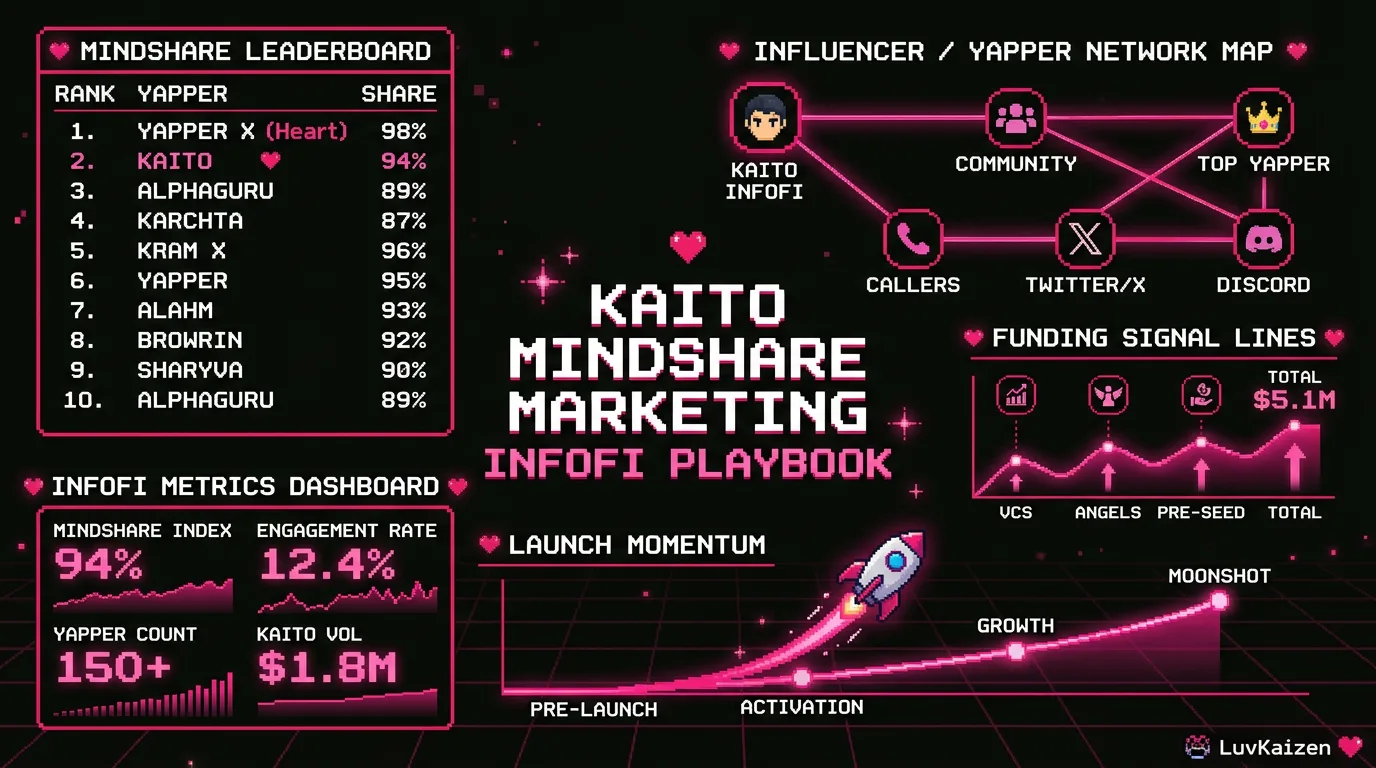
Quick answer: Kaito mindshare marketing uses the InfoFi platform's attention leaderboards to build narrative visibility for pre-TGE crypto projects. The playbook moves through phases: map the relevant yappers, scaffold content themes they can amplify, run the leaderboard phase to reward quality posts, and sustain narrative tactics so mindshare converts into community and investor attention at TGE.
Kaito turned crypto attention into a measurable, tokenized asset. For any team heading into a TGE in 2026, that changes the marketing job from "buy tweets" to "engineer mindshare."
This is the playbook we run for pre-TGE projects targeting the Kaito Yapper Leaderboard. It has produced top-10 mindshare rankings for clients in ecosystems including Hyperliquid, Solana L2s, and AI-agent protocols: without paying a single KOL for a placement.
Why InfoFi rewrote the playbook
Before Kaito, marketing reports were theater. Reach, impressions, engagement: all numbers you could buy. Kaito's algorithm does three things that make that theater collapse:
- Weights creators by historical signal, not follower count. A 10K-follower account that has been consistently right about crypto for two years outscores a 500K vanity account.
- Ranks accounts per-project, so a creator's mindshare contribution to your project depends on their track record in your specific narrative.
- Publishes the leaderboard publicly, which means your competitors see what your mindshare looks like in real time.
Attention stopped being an input and became an asset class. InfoFi (information finance) is the sector that financializes it. Kaito is the dominant venue.
For a pre-TGE project this means one specific thing: your mindshare rank 4 to 6 weeks before TGE predicts your listing-day price action better than any other public metric.
The mindshare ratio that actually matters
The leaderboard number everyone stares at is raw mindshare %. The number we actually engineer for clients is the mindshare-to-funding ratio: how much public attention a project has captured per dollar of VC raised.
Top-tier pre-TGE projects in our dataset sit around 1.2 bps of Kaito mindshare per $1M raised. Below that, the token usually underperforms its funding-implied valuation at TGE. Above it, the token usually beats. This is the single most important KPI we report.
Stage 1: Yapper mapping (weeks -12 to -8 before TGE)
Every narrative on Kaito has a known core of 30 to 60 creators whose posts the algorithm weights heavily. The first job is to identify yours.
What we do:
Pull the current Yapper Leaderboard for the 5 projects closest to yours in narrative
Deduplicate the top 50 yappers across those five lists
Cross-reference posting patterns, DM accessibility, and existing project affiliations
Produce a ranked target list of 40 to 80 yappers
This list is not a spam target. It's a relationship map. The work from this point is about earning genuine attention from those accounts, not paying for it.
Stage 2: Content scaffolding (weeks -8 to -4)
Yappers will not talk about you if there is nothing to talk about. Our clients ship three content scaffolds before we begin outreach:
The thesis post
One 1,500 to 2,500-word long-form piece that lays out why the project exists and why it matters now. Not a whitepaper. A point of view. Published on the founder's personal blog or Mirror. This becomes the artifact every future yapper post can link back to.
The public dashboard
A Dune, Flipside, or Tenderly dashboard that visualizes something unique about the project's design or traction. Yappers amplify on-chain data disproportionately because the algorithm rewards novel, verifiable information.
The weekly alpha drop
A recurring piece of content: a thread, a short video, a numbers post, that the founder publishes every week on a fixed day. Consistency is the thing the algorithm weights hardest.
With these three scaffolds live, the outreach-to-engagement ratio jumps from ~3% (cold DMs) to ~22% (yappers reply because there's something worth engaging with).
Stage 3: The yapper seeding sequence (weeks -4 to -2)
This is the part that looks like traditional marketing and is almost nothing like it.
Forbidden tactics:
Don't DM with a brief.
Don't offer payment for posts.
Don't copy-paste outreach.
Don't send media kits.
What works:
Engage publicly first. Reply to 5 to 10 of the target yapper's posts with real, useful additions. This must be done by the founder, not by the project account.
Send private alpha. Share one non-public metric or observation about the project in DM. Do not ask for a post. They will often post anyway.
Offer asymmetric access. Invite a small group to a founder AMA before the public one. This is not a bribe, it is information asymmetry, which is what yappers trade in.
Over a 14-day window we aim for 12 to 20 of the target list to post organically about the project at least once. Kaito picks up these posts and starts weighting them into your project's mindshare score.
Stage 4: The Yapper Leaderboard launch phase (weeks -2 to TGE)
Kaito often opens a dedicated leaderboard for a project in the two weeks before TGE. This is the actual game.
Once the leaderboard is live:
Rewards design matters more than reward size. A well-designed allocation (e.g. quality tiers, longevity bonuses, anti-sybil anchors) draws higher-quality yappers than a large pool with no structure.
Host a weekly "top yaps" digest. A pinned thread from the project account that highlights the best yapper posts. This is a social signal the algorithm and the community both respond to.
Protect your scaffolding content. Make sure the thesis post, dashboard, and founder alpha drop are the most-linked artifacts in the yapper ecosystem. The algorithm rewards citation.
In this window we're actively tracking mindshare share, yapper count, and average yap quality score. Target numbers for a strong TGE entry: 2 to 6% sector mindshare, 400 to 1,200 unique yappers, top-decile yap quality.
Stage 5: The TGE narrative carry
The day of TGE and the seven days after are where mindshare compounds into price. This is where most projects waste their lead.
What compounds:
Founder posts in real time. Not announcements. Reactions, observations, transparent charts.
Yapper gratitude. A public thread thanking the top 50 yappers by name after TGE. They will rate-amp your project in subsequent posts because they got public recognition.
Follow-on alpha. A second wave of content: post-TGE tokenomics review, airdrop recipient analysis, first-week metrics. The audience wants confirmation they were right.
What kills it:
Going silent on launch day. The founder is too busy, the team is too nervous. This is the single biggest post-TGE mistake.
Hunting for new yappers instead of deepening with the existing ones. The algorithm rewards retention, not breadth.
Killing reward programs too quickly. If the Yapper Leaderboard closes the day of TGE, mindshare collapses within 72 hours.
The InfoFi stack around Kaito
Kaito is the biggest venue but not the only one. A mature 2026 InfoFi strategy includes:
Cookie3 for engagement quality scoring across multiple networks
Galxe for quest-based attention campaigns and credentialing
Polymarket for prediction-market narrative seeding (see our prediction market playbook)
Farcaster for non-X mindshare that Kaito has started indexing
We treat these as a layered stack. Kaito is the reporting layer, the others are where attention is manufactured and measured.
Mistakes that tank pre-TGE mindshare
Paying for mindshare. Kaito's quality weighting means paid placements get de-ranked. You can spend $100K and end the week lower than you started.
Over-indexing on one yapper. If 60% of your mindshare comes from one creator, the algorithm treats it as concentration risk. Breadth of quality yappers beats depth with a single big one.
Writing corporate copy. The algorithm loves founder voice. Project-account content barely registers unless it's technical.
Running the Kaito campaign after TGE. Mindshare is a leading indicator of price. The window is before the listing, not after.
Benchmarks we hit for pre-TGE clients
| Metric | Target (TGE-1 week) | |---|---| | Sector mindshare % | 2.0% to 6.0% | | Unique yappers | 400 to 1,200 | | Top-100 yapper coverage | 55 to 80% | | Mindshare-to-funding ratio (bps / $1M) | > 1.2 | | Founder X follower growth during campaign | +8K to +25K |
These are not universal. They are the shape of a campaign that consistently produces outperforming TGE outcomes across the 11 pre-TGE campaigns we ran in the last 12 months.
How LuvKaizen runs Kaito campaigns
Our mindshare and InfoFi desk designs yapper maps, writes the scaffolding content, orchestrates founder-led seeding, and runs the dashboard/analytics stack that keeps the algorithm feeding on your project.
We are genuinely selective about which projects we take on Kaito work for: the algorithm doesn't forgive weak fundamentals. If you are 60 to 120 days from TGE and considering running a Kaito campaign, book a mindshare review with our team.
Related reading: our Polymarket growth playbook on prediction-market seeding and the Hyperliquid playbook where HyperCrew and Kaito dynamics overlap heavily.
Related reading
Other Blogs
Where Can You Stream Gambling in 2026? Kick, YouTube, Twitch, Rumble and X
A platform by platform overview of where casino and slots streams are allowed in 2026, with the sponsor, link and label rules for each.
read blog
How to Stream Slots on Kick: OBS Setup, Overlays and Rules
A setup guide for slot streamers on Kick: OBS settings from Kick's Help Center, a slots scene with overlays, labels and the gambling rules to follow.
read blog
How to Become a Casino Streamer in 2026: Setup, Rules and Your First Deal
A step by step guide to starting a casino stream in 2026: legal age and licence checks, platform rules, setup, disclosure and growing an audience sponsors pay for.
read blog
Twitch Gambling Sponsorship Rules (2026)
Twitch's 2026 gambling rules in plain English: the six banned sites, the link and code ban, what sponsors can still do and how to disclose.
read blog
Gambling Ad Disclosure Examples for Streamers and Influencers
Copy-ready gambling ad disclosure wording for live streams, clips, posts and affiliate links, checked against FTC and ASA guidance, plus the labels that fail.
read blog
How Much Do Crypto Ads Cost in 2026? CPMs and CPCs by Channel
Real crypto advertising rates by channel: ad networks, Google, X, Telegram, KOLs and clipping compared on cost per 1,000 views and per click.
read blog
Top Kick Streamers in 2026: The Most-Followed Channels Ranked
The most-followed Kick streamers in 2026, what they stream, why LatAm creators dominate the platform, and how brands actually get placements.
read blog
Clipping Agency Pricing in 2026: Rates, CPMs and Models Compared
Real clipping campaign costs in 2026: CPM ranges, pricing models compared, budget examples and the questions that expose overpriced clipping offers.
read blog
Streamer Clipping: How Streams Become Short-Form Reach
How streamer clipping works: the rights-to-verified-views pipeline, real economics for brands and clippers, compliance, and DIY vs managed programs.
read blog
Top Casino Streamers in 2026: Who Moves Audiences
Who the top casino streamers are in 2026, what each tier costs to sponsor, and how operators should pick partners beyond the biggest names.
read blog
How to Hire Casino Streamers: 2026 Operator's Guide
The operator's guide to hiring casino streamers: platforms, vetting, deal structures, rates from $500 to $50K+, and compliance rules by market.
read blog
How to Choose a Crypto Market Maker: 2026 Founder's Guide
Engagement models, contract KPIs, red flags and a 7-step checklist for picking a market maker before your token launch.
read blog
Casino VIP Programs: How to Build One That Keeps High Rollers
Tier design, host playbooks and offer economics: building a VIP program that protects the players who drive most of your GGR.
read blog
Casino Player Retention: The 2026 Guide to Keeping Depositors Active
Most casinos lose 60-80% of new depositors in 30 days. The metrics, flows and mechanics that fix it.
read blog
What Is a Telegram Casino? How They Work and How They Grow
Mini-app casinos, TON payments and one-tap deposits: how Telegram became gambling's fastest-growing surface.
read blog
How to Start a Crypto Casino in 2026: Licensing, Software, Costs and Growth
Licensing, software, payments, budgets and the launch plan: what it actually takes to start a crypto casino in 2026.
read blog
iGaming Affiliate Marketing and Influencer Promotion: How Operators Combine Both in 2026
Affiliates and influencers have merged into one deal market. How operators structure, track and price the hybrid channel in 2026.
read blog
Robinhood Chain vs Base vs Solana: Where to Launch in 2026
An honest comparison on audience, distribution, tooling, liquidity and cost, with a clear pick for each.
read blog
The Robinhood Chain KOL Marketing Playbook
Creator archetypes, vetting, briefing and launch sequencing for a chain most audiences have not added yet.
read blog
How to Launch a Token on Robinhood Chain (2026 Guide)
Step-by-step: network setup, bridging, contract verification, pools.trade mechanics and the launch marketing timeline.
read blog
Robinhood Chain Explained for Crypto Marketers
What Robinhood Chain is, who is actually on it, and how its retail audience changes your go-to-market.
read blog
What Is a Micro-Influencer? Tiers, Rates and How to Find Them in 2026
What actually counts as a micro-influencer, what they charge, and when 50 micros beat one macro name for reach and trust.
read blog
Kalshi Promo Code Guide: What Actually Exists in 2026
No universal Kalshi promo code exists. Here's what's real (referral credits), the scams targeting this search, and how to check today's actual offer.
read blog
Token Farming Explained: Airdrop Farmers, Points Meta and How Projects Fight Back
Token farmers industrialize airdrop hunting. How farming works, what it earns, and how projects design campaigns that survive it.
read blog
Polymarket Invite Codes and Referrals: What Actually Exists in 2026
What's real behind 'Polymarket invite code' searches: how prediction-market referral mechanics work, what to avoid, and what operators can learn.
read blog
What Is a UGC Creator? Meaning, Rates and How to Become One
UGC creators make branded content without needing an audience. What the job is, what it pays, how to start, and how brands should hire.
read blog
Clip Farming: What It Is, How It Works, and How Brands Use It
The complete guide to clip farming: what it means, how clippers industrialize short-form views, what it pays, and how brands harness it safely.
read blog
GEO vs SEO: What's the Difference and Which Do You Need?
Rankings vs citations: what actually differs between SEO and GEO, why they compound, and how to split budget between them in 2026.
read blog
iGaming Clipping Compliance: Licensed Markets, Disclosures and Age Rules
The compliance stack for gambling clip campaigns: where clips can run, what must appear on screen, and how to evidence it, before regulators ask.
read blog
Verified Views: How to Audit a Clipping Campaign for Bot Traffic
The fight in clipping has moved from reach to whose views are real. Here's the audit methodology we run, and invite clients to run on us.
read blog
How Much Does a Clipping Campaign Cost in 2026?
Real 2026 clipping price points across bounty platforms and managed agencies, what a wave includes, and how to budget by goal.
read blog
Whop Clipping and Content Rewards: The Complete 2026 Guide
What Whop clipping and content rewards actually are, what clippers earn, what brands really pay, and where the model breaks, explained for both sides.
read blog
iGaming Affiliate CPA Rates 2026: Benchmarks by Geo and Vertical
The 2026 CPA, RevShare and hybrid benchmarks operators actually sign, by geo tier and vertical, plus the levers that move your rate.
read blog
How to Attribute Clipping Views to FTDs (Without Click Paths)
Clips rarely carry clickable links. These are the four attribution methods that still tie views to first-time depositors, and how to contract them upfront.
read blog
Cost per FTD in iGaming: 2026 Benchmarks and Your CAC Ceiling
FTD benchmarks by channel, geo tier and vertical, plus the LTV method for deciding the most you can afford to pay for a depositor.
read blog
Clipping vs Affiliate CPA for iGaming: The Cost per FTD Math
Affiliates price the depositor. Clipping prices attention. Here's the honest math that converts clip views into cost per FTD, and when each channel wins.
read blog
iGaming Affiliate Marketing: The Operator's Revenue Share Playbook
The definitive operator's playbook for iGaming affiliate marketing, covering RevShare, CPA, and hybrid commission models, affiliate vetting, compliance frameworks, and scaling strategies for crypto casinos.
read blog
Crypto Gambling Marketing: Navigating Compliance While Scaling Player Acquisition
Navigate the complex compliance landscape of crypto gambling marketing across jurisdictions, from KOL disclosure rules and platform policies to building a compliance-first marketing operation that scales.
read blog
iGaming Content Marketing: SEO-Driven Player Acquisition Strategy
Build an iGaming content marketing strategy that drives organic player acquisition through keyword clustering, content funnels, ROI measurement, and scalable production.
read blog
Top 10 iGaming Marketing Trends 2026: AI, Clipping & Crypto-Native Acquisition
Discover the top 10 iGaming marketing trends shaping 2026, from AI-generated content and stream clipping operations to crypto-native acquisition and KOL-led campaigns driving operator growth.
read blog
Short-Form Video for iGaming: TikTok, Reels & Shorts Playbook 2026
The definitive 2026 playbook for iGaming short-form video covering TikTok, Reels, and Shorts strategies for casino and betting brands navigating restricted advertising markets.
read blog
Casino Influencer Compliance: Disclosure, Responsible Gambling & Platform Rules
Navigate casino influencer compliance with this comprehensive guide to disclosure requirements, responsible gambling messaging, platform rules, and audit processes.
read blog
Crypto Sportsbook Marketing: Reaching Wallet-Ready Bettors
Proven crypto sportsbook marketing strategies to reach wallet-ready bettors through KOL partnerships, Telegram and X distribution, live betting content, and on-chain promotions.
read blog
iGaming KOL Marketing: Finding, Vetting & Managing Casino Streamers
Learn how to find, vet, and manage casino streamers and KOLs across Twitch, Kick, YouTube, and X for measurable player acquisition with campaigns that deliver up to 11x ROI.
read blog
Casino UGC Marketing: Why Creator Content Wins in Regulated Markets
Discover why user-generated content outperforms paid ads for casino and sportsbook operators in regulated markets, and how to build a scalable UGC program with proper creator sourcing, compliance, and ROI measurement.
read blog
iGaming Community Building: Telegram, Discord & Reddit Playbook
Master iGaming community building on Telegram, Discord, and Reddit with proven strategies for player retention, engagement mechanics, and converting members to depositors.
read blog
The Rise of Sweepstakes Casinos: Marketing Strategy Guide for 2026
A comprehensive guide to sweepstakes casino marketing in 2026, covering social media strategies, influencer partnerships, SEO, community building, and paid acquisition tactics.
read blog
How Casino Brands Use Clipping to Replace Banned Ads With Organic Reach
Learn how casino brands use stream clipping to bypass ad bans and drive organic reach through scalable content operations, compliance frameworks, and multi-platform distribution.
read blog
Sports Betting Influencer Marketing: Beyond the Tipster Model
Move beyond tipster-only sports betting influencer strategies. Learn how lifestyle creators, match-day content, and multi-platform campaigns drive sustainable FTD growth.
read blog
How to Market a Crypto Casino in 2026: The Full Playbook
The complete crypto casino marketing playbook for 2026 covering KOL strategy, SEO, UGC, affiliate programs, community building, and on-chain attribution for operators looking to scale player acquisition.
read blog
iGaming SEO: The Complete 2026 Guide to Ranking Casino & Sportsbook Sites
Master iGaming SEO in 2026 with this comprehensive guide covering technical foundations, keyword strategy, content architecture, link building, and AI Overview optimization for casino and sportsbook sites.
read blog
Blockchain UGC Content Strategy: Making Technical Products Legible
How to build UGC for technically complex blockchain products, from creator archetypes to measurement tied to testnet activity.
read blog
Crypto UGC Agency vs Freelancers vs In-House: Real Costs Compared
Four production models priced honestly, including management hours and rework, with a decision framework by monthly asset volume.
read blog
How to Choose a Crypto UGC Agency in 2026
A nine-criteria evaluation framework, a weighted scorecard, and the sales-call answers that should end the conversation.
read blog
Crypto UGC Hooks That Convert: 12 Formats With Examples
Twelve proven crypto UGC hook formats with example script openings, funnel fit, failure modes, and a system for testing hooks and reading win rates.
read blog
The Web3 UGC Creator Program Playbook
How to stand up a crypto creator program inside a Web3 community: tiers, incentives, briefs, QA, payouts, anti-farming controls and a 30/60/90 day rollout.
read blog
Crypto KOL List 2026: How to Build One That Actually Converts
Most crypto KOL lists rank by follower count, which predicts almost nothing. Here are the seven fields that actually forecast whether a placement converts.
read blog
Crypto Media List 2026: Outlets, Tiers, Link Types and Turnaround
The crypto media list most PR providers will not show you: how outlets tier, what dofollow status is worth, and the five fields to demand before paying.
read blog
Crypto Guest Posting Sites: Where to Publish in 2026
The crypto guest posting landscape in 2026: which sites accept contributions, what placements cost, and how to build links that actually move rankings.
read blog
Best Crypto Subreddits to Follow in 2026
The crypto subreddits actually worth following in 2026 (news, trading, DeFi and dev communities), plus how to market on Reddit without getting banned.
read blog
Top Crypto Discord Servers to Join in 2026
The best crypto Discord servers in 2026 across trading, DeFi, NFT, developer and ecosystem communities, and what makes a server worth joining.
read blog
The TGE Checklist: What to Lock Before You Launch
The pre-launch checklist that separates TGEs that build a base from launches that spike and die.
read blog
TGE vs ICO vs IDO vs IEO: What's the Difference?
The four token launch models explained, and which one actually fits your project in 2026.
read blog
Crypto Newsletter Sponsorships: The 2026 Guide (Pricing, Top Letters, Playbook)
How to buy crypto newsletter sponsorships that convert: pricing benchmarks, list vetting, formats, and the multi-send playbook.
read blog
Crypto KOL Marketplace vs. Agency: Which Gets You Better ROI in 2026?
Self-serve KOL marketplace or managed agency? A practical comparison of cost, speed, vetting and ROI, and when hybrid wins.
read blog
How Much Does a Crypto Press Release Cost in 2026? (Real Pricing by Outlet)
Real 2026 pricing for crypto press releases: per outlet, per wire bundle, and per top-tier placement, plus the hidden fees nobody mentions.
read blog
Where to Submit a Crypto Press Release in 2026 (15+ Outlets & Wires Compared)
Every serious option for crypto press release submission in 2026 (top-tier media, newswires, aggregators) with pricing benchmarks and pickup expectations.
read blog
Crypto Link Building: How to Get Backlinks That Actually Rank (2026)
Quality crypto backlinks are scarce, which is why they work. Seven tactics that earn links editors actually give, plus the traps that get web3 sites penalized.
read blog
Best Crypto SEO Tools in 2026 (What We Actually Use)
From keyword research to AI-citation tracking: the SEO tool stack we use across 300+ web3 projects, with what each tool is actually good for.
read blog
IDO Marketing Guide 2026: How to Launch a Token Sale That Sells Out
The hype-only IDO model is dead. Here's the 2026 playbook: launchpad selection, alpha-group KOLs, whitelist gamification and a week-by-week timeline.
read blog
AEO & GEO for Crypto: How to Get Cited by ChatGPT, Perplexity & AI Overviews
Over half of Google queries now trigger AI Overviews. Here's how crypto projects get cited by ChatGPT, Perplexity and Gemini: the complete AEO/GEO playbook.
read blog
How to Market a Crypto Exchange in 2026: The Complete Playbook
Registrations are easy; funded accounts are the business. The full 2026 playbook for CEX and DEX user acquisition: channels, budgets and metrics.
read blog
How to Become a Crypto Marketer in 2026 (Salaries, Skills, Paths)
Salary bands, real skills, and the fastest path in, from a team that hires crypto marketers.
read blog
How to Get People to Buy Your Crypto: The 2026 Demand Playbook
Demand = narrative × distribution × trust. The honest playbook, step by step.
read blog
What Does a Crypto Marketing Agency Do? (And When to Hire One)
The services, the costs, the red flags, and when an agency beats in-house.
read blog
KOL Campaign Wallet Activation Benchmarks (2026)
What a KOL campaign actually produces in funded wallets: 2026 planning bands by product category, funnel math, attribution setup, and the three decisions the numbers drive.
read blog
Crypto Casino Marketing Strategies That Work in 2026
Eight crypto casino marketing strategies that actually work in 2026, with cost bands per channel and a plan for combining them at test, scale, and aggressive budgets.
read blog
Crypto KOL Rate Report 2026: Real Rates From a 5,000+ Creator Network
Real 2026 crypto KOL rates from 5,000+ creators and 500+ campaigns: per-tier pricing, platform premiums, exclusivity costs and what each budget actually buys.
read blog
Whop Clipping vs Managed Clipping: Which Should You Run?
Whop clipping bounties vs managed clipping campaigns: real rates, fraud risk, compliance, and a decision framework for crypto teams.
read blog
UGC Video Rates 2026
UGC video rates in 2026: marketplaces charge $25 to 120 per video, managed campaigns run $15K to $100K+. Rate tables, crypto premiums, and budget guides.
read blog
Top Prediction Market KOLs to Watch in 2026
The prediction market KOLs to know in 2026: Domer, French Whale, Swiss Tony, Gunther Eagleman, PredMTrader, plus the archetypes brands actually hire.
read blog
Top Crypto TikTok Influencers & Instagram Creators 2026
The 6 types of crypto TikTok influencers and Instagram creators that matter in 2026, typical rates by tier, and how to vet them before you pay.
read blog
Short Form Video ROI Benchmarks 2026
Short form video ROI benchmarks 2026: #1 ROI format for up to 77% of marketers, 200B+ daily Shorts views, $1 to 5 clipping CPMs. Every stat sourced.
read blog
MiCA Licensing Guide 2026: Licensed or Locked Out
MiCA licensing in 2026: who needs a CASP license, €50k to €150k capital, real costs, timelines, jurisdictions, and the 1 July grandfathering cutoff.
read blog
Kick Streamer Casino Sponsorships Guide
How Kick streamer sponsorships work in 2026: casino rates, deal structures, platform rules, picking streamers, and clipping streams for reach.
read blog
Kalshi Marketing Playbook: How a $22B Exchange Grew
Kalshi marketing teardown: $17.7M TV, celebrity ads, a CNBC data deal, $500-per-post affiliates. What worked, what regulators flagged, where KOLs fit.
read blog
How to Make Crypto Videos Go Viral
How to make crypto videos go viral: hooks, clipping distribution, and policy arbitrage. One 60-min AMA yields 40 to 60 clips. The 2026 playbook.
read blog
The Crypto Exchange KOL Playbook
How crypto exchange KOL programs work: Binance, Bybit, Bitget, MEXC and Gate numbers, CPA vs rev-share math, and what in-house programs miss.
read blog
Casino Influencer Marketing Cost
Casino influencer marketing cost in 2026: $500 to $5K mid-size streamers, $10K to $50K+ top creators, $50 to $250 CPA per FTD. Full rate tables and budget plans.
read blog
Crypto Marketing Agency vs In-House: Which Is Right?
Agency or in-house for crypto marketing? An honest cost/benefit breakdown.
read blog
12 Best Crypto Community Management Tools in 2026
The tools that keep crypto Telegram and Discord communities safe and active.
read blog
The Crypto Marketing KPIs That Actually Matter in 2026
The metrics that prove (or disprove) your crypto marketing is working.
read blog
Is Crypto KOL Marketing Worth It? (Honest 2026 Take)
An honest take on when crypto KOL marketing pays off, and when it doesn't.
read blog
DeFi Marketing Strategy: A 2026 Playbook
How to market DeFi to skeptical, yield-savvy users and grow TVL.
read blog
How to Make a Meme Coin Go Viral in 2026
The mechanics behind memecoins that actually go viral.
read blog
Meme Coin Marketing Strategy: A 2026 Framework
A repeatable framework for memecoin marketing that compounds.
read blog
How to Market a Crypto Presale in 2026 (Step-by-Step)
The step-by-step playbook to sell out a crypto presale.
read blog
Crypto Influencer Marketing ROI: How to Measure It
How to actually measure and improve KOL campaign ROI.
read blog
How to Find Crypto Influencers (and Vet Them) in 2026
How to find and vet crypto KOLs that actually drive results.
read blog
How to Grow a Crypto Community in 2026 (Telegram & Discord)
A practical guide to building an active crypto community that lasts.
read blog
Frequently Asked Questions
Can you pay your way to the top of the Kaito leaderboard?
Not durably. Kaito's algorithm weights creators by historical signal quality, which means paid placements from low-signal accounts actually hurt. Paying your way to the top has been attempted and publicly debunked several times. What works is earning attention from high-signal yappers through real information, real access, and a real founder voice.
How early before TGE should we start Kaito marketing?
The ideal runway is 10 to 12 weeks. The content scaffolding, yapper mapping, and seeding sequence all need time. Projects that try to compress this into 2 to 4 weeks often see mindshare rise and then collapse before TGE because the attention wasn't rooted in genuine relationships.
What budget range does a Kaito campaign require?
Most of the spend is on people, not placements. Content scaffolding, analytics, and campaign ops typically run $40K to $120K for a 10-week program. Airdrop allocations to yappers are a separate line and are paid in token, not cash.
Do you work with projects that don't have a token yet?
Yes, pre-token projects are the bulk of our Kaito work. Mindshare established before TGE is the asset. The reward programs are sized against the future token, so it's a token-denominated marketing budget rather than a cash one.
How do you measure success?
Three numbers: final sector mindshare % at TGE, mindshare-to-funding ratio, and top-quartile yapper retention in the 30 days after TGE. We publish these privately to each client but share anonymized aggregates quarterly.
What Sets Us Apart
Strategic marketing solutions tailored for the decentralized future

Blockchain Marketing Expertise
We understand DeFi, NFTs, and crypto projects inside and out. We make your project more visible and get more people using it.

24/7 Community Management
We build active Web3 communities people want to join. We handle moderation and protect from scammers and spam.

Crypto Native PR & Media
We get your project featured in crypto publications and connect you with blockchain influencers who matter.

Data-Driven Growth Hacking
We use real blockchain data to improve your marketing. Just strategies that work based on actual numbers.

Comprehensive Web3 Services
We handle everything from token launches to Web3 branding to app promotion. One team for all marketing needs.

Proven Blockchain Success
We've helped 300+ Web3 projects grow since 2018, including DeFi protocols, NFT marketplaces, and Layer 2 solutions.
We’re thrilled to dive into your Web3 project and uncover how LuvKaizen can supercharge your growth!
Here’s the agenda for our call:
Intro and what is LuvKaizen
Project or/and whitepaper overview
Your core marketing goals
How the LuvKaizen process works
Any questions about Web3 marketing
We look forward to discussing how LuvKaizen can accelerate your Web3 project’s success and help you achieve your goals.
See you soon!
Oops! Something went wrong while submitting the form.