-3.svg)
Pump.fun Marketing Playbook 2026: Fair Launch to Raydium Graduation
April 27, 2026
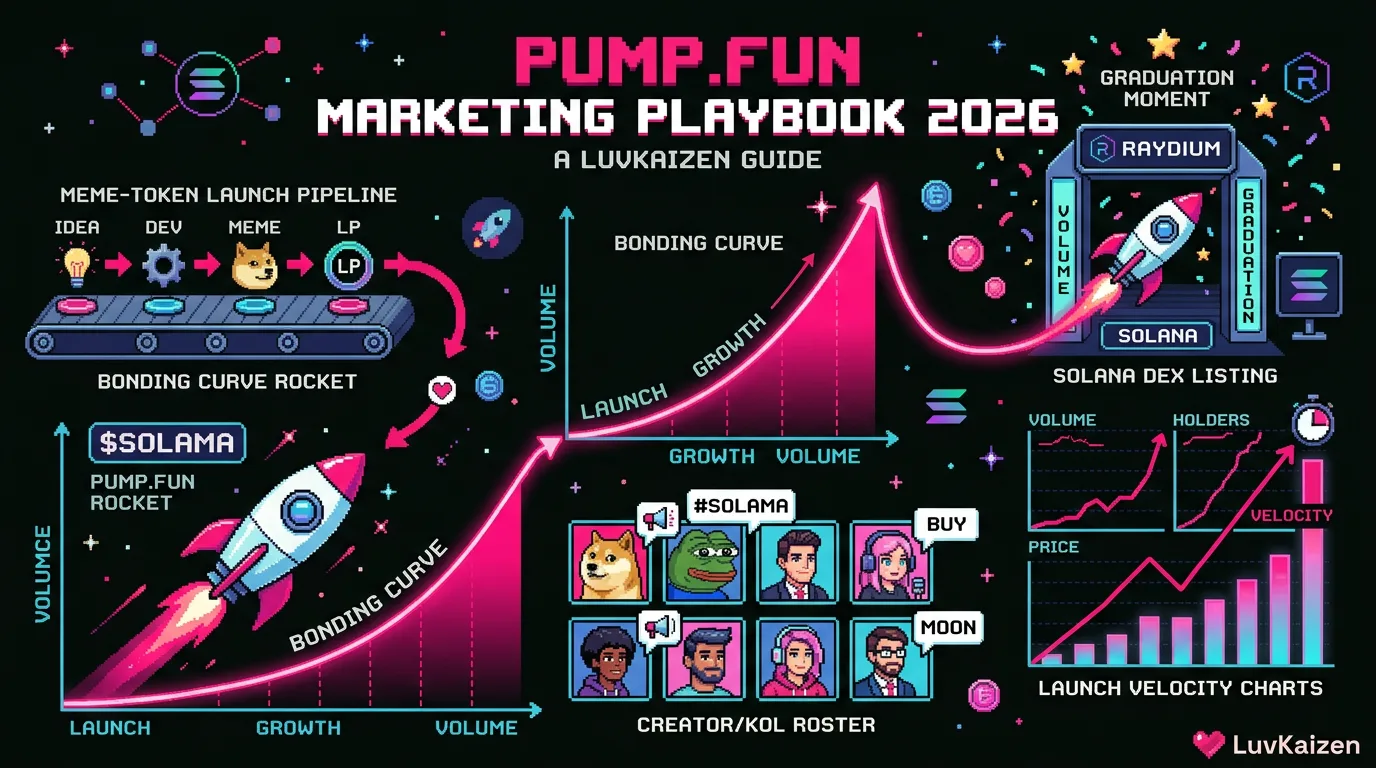
Quick answer: Pump.fun marketing in 2026 runs in four phases: pre-bond stealth to seed a core community, building bonding curve velocity with coordinated content pushes, graduating to Raydium with liquidity and narrative intact, and post-graduation survival tactics that retain holders. Because most tokens stall after bonding, momentum planning matters more than launch-day hype.
Pump.fun did over $2B in DEX volume in Q1 2026. Most of that volume went to the same 200 wallets. Not because those wallets are smarter, but because their teams actually marketed the launch.
Everyone else minted a coin, tweeted once, and watched the bonding curve die at $18K market cap.
This is the playbook we run for clients who want to graduate to Raydium, keep the chart alive past day three, and not get classed as a soft-rug by aggregators. It's the same framework our team used on Polymarket's prediction-market cycle and adapted to pump.fun's fair-launch meta.
Why pump.fun marketing is not "memecoin marketing"
Traditional memecoin marketing assumes a pre-sale, a private round, a whitelist, and weeks of teaser content. Pump.fun deletes all of that.
You mint in one click. The token is live, tradable, and on a public bonding curve the moment the transaction lands. There is no pre-launch window. There is no private allocation. If your marketing doesn't exist before the contract address exists, your launch is already over.
This changes the job entirely. Pump.fun marketing is:
Stealth narrative in the 48 to 72 hours before mint
Velocity on the bonding curve in the first 3 hours after mint
Graduation liquidity at the $69K market-cap threshold
Post-Raydium survival for the 72 hours after graduation when 80% of tokens die
Miss any of these four and you join the graveyard of 4M+ dead pump.fun tokens.
Stage 1: The pre-bond stealth window (T-72h to mint)
This is the part every rug pull and every real project share: you have to pre-warm an audience without revealing the contract. The difference is in how honest you are about what you're building.
The KOL pre-bond signal
We line up 8 to 15 Key Opinion Leaders before the contract exists. Their job is not to shill: pump.fun flags that fast. Their job is to plant a narrative seed: a meme format, a character, a niche belief, an inside joke the target community already half-believes.
Stealth KOL framing that still converts:
"Someone's cooking something around [narrative]. I'll share the CA when it's live."
Posting a shitpost that uses the eventual ticker as a gag before the ticker exists.
Dropping a meme image 36 hours out that people save and re-share without knowing it's a token.
The goal: by the time you tweet the CA, the memetic surface area already exists. You are not introducing a token. You are completing a pattern the audience has been staring at for two days.
Wallet pre-fund and sniper prep
You also want 20 to 40 friendly wallets funded with 0.3 to 1 SOL each, geographically distributed, ready to hit the buy button within the first two blocks. Not to inflate, but to anchor. Snipers will ape anything that prints green candles on a freshly minted curve. Your own warm wallets make the first 3 minutes look real.
Stage 2: Bonding curve velocity (T+0 to T+3 hours)
Pump.fun's bonding curve is a simple exponential. Early buyers pay cents, late buyers pay dollars. The psychological job of the first 3 hours is convincing the market that this is the one.
The 3-tweet cadence
Tweet 1 (T+0): CA + one-line narrative. No promises, no "1000x". One meme, one hook.
Tweet 2 (T+20m): First holder milestone + a second meme. Pin this.
Tweet 3 (T+60m): Screenshot of chart + KOL retweets rolling in.
Between tweets you're firing Telegram raids, replying to every quote tweet, and pushing your pre-bond KOL roster to post their own CAs with their personal framing: never copy-paste, always their voice.
The "no-hope" hour (T+90m)
Almost every pump.fun launch has a terrifying 15 to 30 minute window around the 90-minute mark where the curve flattens and sniper wallets dump. Unprepared teams panic-tweet here. The market smells it.
The move: drop a piece of earned content in this window. A previously-recorded short from a Tier-1 KOL that had been held back. A screenshot of an on-chain identity buying in. A real-world artifact (IRL photo, merch, app demo) that proves there's something behind the ticker besides a curve. This is where most graduations are won or lost.
Stage 3: Graduation to Raydium (≈$69K market cap)
Graduation is where pump.fun stops holding your hand. The bonding curve ends, LP is seeded on Raydium, and suddenly you're a normal SPL-20 with a chart anyone can short.
The liquidity shock
The moment of graduation always triggers a price wick. Wide-eyed holders hit sell. New buyers wait for the wick to finish. In that 4 to 8 minute window you need two things:
- A pre-briefed KOL wave. They post buy confirmations at the dip, not at the top. This was coordinated in the pre-bond Telegram: they were told "do not post at launch, post when we graduate."
- A pinned "we graduated" thread that stacks all the social proof built during the curve phase: notable buyers, meme references, partnerships (if any).
Raydium-only marketing shifts
Once on Raydium you are competing with every other live Solana ticker. Pump.fun's internal feed no longer surfaces you. Your marketing has to move off-platform:
DexScreener / DEXTools trending buys to stay visible
Banner ads on CoinMarketCap / CoinGecko once you hit listing criteria
Cross-Solana integrations: getting into a Jupiter route, a Phantom search result, a Birdeye trending list
The brand goes from "meme on a curve" to "ticker with a ticker chart." Your content has to follow.
Stage 4: Post-graduation survival (T+72h onward)
80% of graduated pump.fun tokens are below their graduation market cap within 7 days. The ones that survive all do the same thing: they stop being memecoins and start being communities with a ticker.
The community handoff
By day three, the narrative must belong to the holders, not the team. That means:
Holder-gated Telegram / Discord with daily prompts, meme contests, raid coordination
A loose canon of in-jokes that new holders have to learn (unironically one of the strongest retention mechanics in crypto)
Daily rituals: a GM post, a candle-check, a "who bought today" thread. Rituals turn volatility into content.
The unlock-free months
The tokens that 10x from graduation all share a sneaky trait: the founding team doesn't sell in the first 30 days. Publicly. On-chain. Verifiable.
This is a marketing tactic as much as it is an integrity tactic. Pin a tweet with your dev wallet. Let anyone track it. Every week that wallet doesn't move is a piece of content you can make about how you're not most teams.
KPIs we track for every pump.fun launch
Pre-bond: Narrative impressions on X and Telegram target 250K+. Bonding curve: time-to-50%-curve under 2 hours and unique holders at graduation above 400. Graduation: first-60-minute volume on Raydium above $500K. Post-graduation D+7: holders retained above 60% of graduation holders. Post-graduation D+30: daily active chat contributors above 80.
These numbers are benchmarks from 14 pump.fun launches we've supported in the last 9 months. They're not guarantees: they're the shape of the graph when a launch is on track.
Mistakes that kill 90% of pump.fun launches
Tweeting the CA cold. No pre-bond = no pre-audience = dead curve.
Paying one celebrity KOL for a single post. Snipers see the post, snipe, dump. Always use a layered KOL wave of 8 to 15 mid-tier accounts.
Ignoring the 90-minute lull. Teams panic-shill and look desperate. Real teams have reserve content for this window.
Celebrating graduation and going quiet. Graduation is the halfway point, not the finish line.
Promising a roadmap. Fair-launch audiences punish roadmap PDFs. Promise vibes, deliver utility later, never the other way around.
What serious founders are doing differently in 2026
The meta has already moved past "launch a meme and hope." Teams that are graduating multiple tokens back-to-back (and, importantly, keeping most of them alive past the 30-day mark) share three habits:
- They treat the launch as day 30 of a campaign, not day 1.
- They run the KOL wave as a permanent roster across multiple tickers, not a one-off cast.
- They pair pump.fun tokens with another narrative asset (a Telegram mini-app, a prediction market, an agent) so the ticker is never the only reason to pay attention.
That last one is how we work with most of our pump.fun clients: the token is the tip of the spear, but the attention compounds because there's a product behind it.
Run this playbook with LuvKaizen
We operate a dedicated pump.fun marketing desk covering pre-bond narrative design, 8 to 15 KOL pre-briefs, bonding-curve velocity ops, graduation coordination, and the first 30 days on Raydium. If you're planning a fair-launch inside the next 60 days, book a launch review and we'll map your specific narrative window before your mint window.
For deeper adjacent playbooks, see our crypto influencer marketing desk.
Related reading
Other Blogs
Where Can You Stream Gambling in 2026? Kick, YouTube, Twitch, Rumble and X
A platform by platform overview of where casino and slots streams are allowed in 2026, with the sponsor, link and label rules for each.
read blog
How to Stream Slots on Kick: OBS Setup, Overlays and Rules
A setup guide for slot streamers on Kick: OBS settings from Kick's Help Center, a slots scene with overlays, labels and the gambling rules to follow.
read blog
How to Become a Casino Streamer in 2026: Setup, Rules and Your First Deal
A step by step guide to starting a casino stream in 2026: legal age and licence checks, platform rules, setup, disclosure and growing an audience sponsors pay for.
read blog
Twitch Gambling Sponsorship Rules (2026)
Twitch's 2026 gambling rules in plain English: the six banned sites, the link and code ban, what sponsors can still do and how to disclose.
read blog
Gambling Ad Disclosure Examples for Streamers and Influencers
Copy-ready gambling ad disclosure wording for live streams, clips, posts and affiliate links, checked against FTC and ASA guidance, plus the labels that fail.
read blog
How Much Do Crypto Ads Cost in 2026? CPMs and CPCs by Channel
Real crypto advertising rates by channel: ad networks, Google, X, Telegram, KOLs and clipping compared on cost per 1,000 views and per click.
read blog
Top Kick Streamers in 2026: The Most-Followed Channels Ranked
The most-followed Kick streamers in 2026, what they stream, why LatAm creators dominate the platform, and how brands actually get placements.
read blog
Clipping Agency Pricing in 2026: Rates, CPMs and Models Compared
Real clipping campaign costs in 2026: CPM ranges, pricing models compared, budget examples and the questions that expose overpriced clipping offers.
read blog
Streamer Clipping: How Streams Become Short-Form Reach
How streamer clipping works: the rights-to-verified-views pipeline, real economics for brands and clippers, compliance, and DIY vs managed programs.
read blog
Top Casino Streamers in 2026: Who Moves Audiences
Who the top casino streamers are in 2026, what each tier costs to sponsor, and how operators should pick partners beyond the biggest names.
read blog
How to Hire Casino Streamers: 2026 Operator's Guide
The operator's guide to hiring casino streamers: platforms, vetting, deal structures, rates from $500 to $50K+, and compliance rules by market.
read blog
How to Choose a Crypto Market Maker: 2026 Founder's Guide
Engagement models, contract KPIs, red flags and a 7-step checklist for picking a market maker before your token launch.
read blog
Casino VIP Programs: How to Build One That Keeps High Rollers
Tier design, host playbooks and offer economics: building a VIP program that protects the players who drive most of your GGR.
read blog
Casino Player Retention: The 2026 Guide to Keeping Depositors Active
Most casinos lose 60-80% of new depositors in 30 days. The metrics, flows and mechanics that fix it.
read blog
What Is a Telegram Casino? How They Work and How They Grow
Mini-app casinos, TON payments and one-tap deposits: how Telegram became gambling's fastest-growing surface.
read blog
How to Start a Crypto Casino in 2026: Licensing, Software, Costs and Growth
Licensing, software, payments, budgets and the launch plan: what it actually takes to start a crypto casino in 2026.
read blog
iGaming Affiliate Marketing and Influencer Promotion: How Operators Combine Both in 2026
Affiliates and influencers have merged into one deal market. How operators structure, track and price the hybrid channel in 2026.
read blog
Robinhood Chain vs Base vs Solana: Where to Launch in 2026
An honest comparison on audience, distribution, tooling, liquidity and cost, with a clear pick for each.
read blog
The Robinhood Chain KOL Marketing Playbook
Creator archetypes, vetting, briefing and launch sequencing for a chain most audiences have not added yet.
read blog
How to Launch a Token on Robinhood Chain (2026 Guide)
Step-by-step: network setup, bridging, contract verification, pools.trade mechanics and the launch marketing timeline.
read blog
Robinhood Chain Explained for Crypto Marketers
What Robinhood Chain is, who is actually on it, and how its retail audience changes your go-to-market.
read blog
What Is a Micro-Influencer? Tiers, Rates and How to Find Them in 2026
What actually counts as a micro-influencer, what they charge, and when 50 micros beat one macro name for reach and trust.
read blog
Kalshi Promo Code Guide: What Actually Exists in 2026
No universal Kalshi promo code exists. Here's what's real (referral credits), the scams targeting this search, and how to check today's actual offer.
read blog
Token Farming Explained: Airdrop Farmers, Points Meta and How Projects Fight Back
Token farmers industrialize airdrop hunting. How farming works, what it earns, and how projects design campaigns that survive it.
read blog
Polymarket Invite Codes and Referrals: What Actually Exists in 2026
What's real behind 'Polymarket invite code' searches: how prediction-market referral mechanics work, what to avoid, and what operators can learn.
read blog
What Is a UGC Creator? Meaning, Rates and How to Become One
UGC creators make branded content without needing an audience. What the job is, what it pays, how to start, and how brands should hire.
read blog
Clip Farming: What It Is, How It Works, and How Brands Use It
The complete guide to clip farming: what it means, how clippers industrialize short-form views, what it pays, and how brands harness it safely.
read blog
GEO vs SEO: What's the Difference and Which Do You Need?
Rankings vs citations: what actually differs between SEO and GEO, why they compound, and how to split budget between them in 2026.
read blog
iGaming Clipping Compliance: Licensed Markets, Disclosures and Age Rules
The compliance stack for gambling clip campaigns: where clips can run, what must appear on screen, and how to evidence it, before regulators ask.
read blog
Verified Views: How to Audit a Clipping Campaign for Bot Traffic
The fight in clipping has moved from reach to whose views are real. Here's the audit methodology we run, and invite clients to run on us.
read blog
How Much Does a Clipping Campaign Cost in 2026?
Real 2026 clipping price points across bounty platforms and managed agencies, what a wave includes, and how to budget by goal.
read blog
Whop Clipping and Content Rewards: The Complete 2026 Guide
What Whop clipping and content rewards actually are, what clippers earn, what brands really pay, and where the model breaks, explained for both sides.
read blog
iGaming Affiliate CPA Rates 2026: Benchmarks by Geo and Vertical
The 2026 CPA, RevShare and hybrid benchmarks operators actually sign, by geo tier and vertical, plus the levers that move your rate.
read blog
How to Attribute Clipping Views to FTDs (Without Click Paths)
Clips rarely carry clickable links. These are the four attribution methods that still tie views to first-time depositors, and how to contract them upfront.
read blog
Cost per FTD in iGaming: 2026 Benchmarks and Your CAC Ceiling
FTD benchmarks by channel, geo tier and vertical, plus the LTV method for deciding the most you can afford to pay for a depositor.
read blog
Clipping vs Affiliate CPA for iGaming: The Cost per FTD Math
Affiliates price the depositor. Clipping prices attention. Here's the honest math that converts clip views into cost per FTD, and when each channel wins.
read blog
iGaming Affiliate Marketing: The Operator's Revenue Share Playbook
The definitive operator's playbook for iGaming affiliate marketing, covering RevShare, CPA, and hybrid commission models, affiliate vetting, compliance frameworks, and scaling strategies for crypto casinos.
read blog
Crypto Gambling Marketing: Navigating Compliance While Scaling Player Acquisition
Navigate the complex compliance landscape of crypto gambling marketing across jurisdictions, from KOL disclosure rules and platform policies to building a compliance-first marketing operation that scales.
read blog
iGaming Content Marketing: SEO-Driven Player Acquisition Strategy
Build an iGaming content marketing strategy that drives organic player acquisition through keyword clustering, content funnels, ROI measurement, and scalable production.
read blog
Top 10 iGaming Marketing Trends 2026: AI, Clipping & Crypto-Native Acquisition
Discover the top 10 iGaming marketing trends shaping 2026, from AI-generated content and stream clipping operations to crypto-native acquisition and KOL-led campaigns driving operator growth.
read blog
Short-Form Video for iGaming: TikTok, Reels & Shorts Playbook 2026
The definitive 2026 playbook for iGaming short-form video covering TikTok, Reels, and Shorts strategies for casino and betting brands navigating restricted advertising markets.
read blog
Casino Influencer Compliance: Disclosure, Responsible Gambling & Platform Rules
Navigate casino influencer compliance with this comprehensive guide to disclosure requirements, responsible gambling messaging, platform rules, and audit processes.
read blog
Crypto Sportsbook Marketing: Reaching Wallet-Ready Bettors
Proven crypto sportsbook marketing strategies to reach wallet-ready bettors through KOL partnerships, Telegram and X distribution, live betting content, and on-chain promotions.
read blog
iGaming KOL Marketing: Finding, Vetting & Managing Casino Streamers
Learn how to find, vet, and manage casino streamers and KOLs across Twitch, Kick, YouTube, and X for measurable player acquisition with campaigns that deliver up to 11x ROI.
read blog
Casino UGC Marketing: Why Creator Content Wins in Regulated Markets
Discover why user-generated content outperforms paid ads for casino and sportsbook operators in regulated markets, and how to build a scalable UGC program with proper creator sourcing, compliance, and ROI measurement.
read blog
iGaming Community Building: Telegram, Discord & Reddit Playbook
Master iGaming community building on Telegram, Discord, and Reddit with proven strategies for player retention, engagement mechanics, and converting members to depositors.
read blog
The Rise of Sweepstakes Casinos: Marketing Strategy Guide for 2026
A comprehensive guide to sweepstakes casino marketing in 2026, covering social media strategies, influencer partnerships, SEO, community building, and paid acquisition tactics.
read blog
How Casino Brands Use Clipping to Replace Banned Ads With Organic Reach
Learn how casino brands use stream clipping to bypass ad bans and drive organic reach through scalable content operations, compliance frameworks, and multi-platform distribution.
read blog
Sports Betting Influencer Marketing: Beyond the Tipster Model
Move beyond tipster-only sports betting influencer strategies. Learn how lifestyle creators, match-day content, and multi-platform campaigns drive sustainable FTD growth.
read blog
How to Market a Crypto Casino in 2026: The Full Playbook
The complete crypto casino marketing playbook for 2026 covering KOL strategy, SEO, UGC, affiliate programs, community building, and on-chain attribution for operators looking to scale player acquisition.
read blog
iGaming SEO: The Complete 2026 Guide to Ranking Casino & Sportsbook Sites
Master iGaming SEO in 2026 with this comprehensive guide covering technical foundations, keyword strategy, content architecture, link building, and AI Overview optimization for casino and sportsbook sites.
read blog
Blockchain UGC Content Strategy: Making Technical Products Legible
How to build UGC for technically complex blockchain products, from creator archetypes to measurement tied to testnet activity.
read blog
Crypto UGC Agency vs Freelancers vs In-House: Real Costs Compared
Four production models priced honestly, including management hours and rework, with a decision framework by monthly asset volume.
read blog
How to Choose a Crypto UGC Agency in 2026
A nine-criteria evaluation framework, a weighted scorecard, and the sales-call answers that should end the conversation.
read blog
Crypto UGC Hooks That Convert: 12 Formats With Examples
Twelve proven crypto UGC hook formats with example script openings, funnel fit, failure modes, and a system for testing hooks and reading win rates.
read blog
The Web3 UGC Creator Program Playbook
How to stand up a crypto creator program inside a Web3 community: tiers, incentives, briefs, QA, payouts, anti-farming controls and a 30/60/90 day rollout.
read blog
Crypto KOL List 2026: How to Build One That Actually Converts
Most crypto KOL lists rank by follower count, which predicts almost nothing. Here are the seven fields that actually forecast whether a placement converts.
read blog
Crypto Media List 2026: Outlets, Tiers, Link Types and Turnaround
The crypto media list most PR providers will not show you: how outlets tier, what dofollow status is worth, and the five fields to demand before paying.
read blog
Crypto Guest Posting Sites: Where to Publish in 2026
The crypto guest posting landscape in 2026: which sites accept contributions, what placements cost, and how to build links that actually move rankings.
read blog
Best Crypto Subreddits to Follow in 2026
The crypto subreddits actually worth following in 2026 (news, trading, DeFi and dev communities), plus how to market on Reddit without getting banned.
read blog
Top Crypto Discord Servers to Join in 2026
The best crypto Discord servers in 2026 across trading, DeFi, NFT, developer and ecosystem communities, and what makes a server worth joining.
read blog
The TGE Checklist: What to Lock Before You Launch
The pre-launch checklist that separates TGEs that build a base from launches that spike and die.
read blog
TGE vs ICO vs IDO vs IEO: What's the Difference?
The four token launch models explained, and which one actually fits your project in 2026.
read blog
Crypto Newsletter Sponsorships: The 2026 Guide (Pricing, Top Letters, Playbook)
How to buy crypto newsletter sponsorships that convert: pricing benchmarks, list vetting, formats, and the multi-send playbook.
read blog
Crypto KOL Marketplace vs. Agency: Which Gets You Better ROI in 2026?
Self-serve KOL marketplace or managed agency? A practical comparison of cost, speed, vetting and ROI, and when hybrid wins.
read blog
How Much Does a Crypto Press Release Cost in 2026? (Real Pricing by Outlet)
Real 2026 pricing for crypto press releases: per outlet, per wire bundle, and per top-tier placement, plus the hidden fees nobody mentions.
read blog
Where to Submit a Crypto Press Release in 2026 (15+ Outlets & Wires Compared)
Every serious option for crypto press release submission in 2026 (top-tier media, newswires, aggregators) with pricing benchmarks and pickup expectations.
read blog
Crypto Link Building: How to Get Backlinks That Actually Rank (2026)
Quality crypto backlinks are scarce, which is why they work. Seven tactics that earn links editors actually give, plus the traps that get web3 sites penalized.
read blog
Best Crypto SEO Tools in 2026 (What We Actually Use)
From keyword research to AI-citation tracking: the SEO tool stack we use across 300+ web3 projects, with what each tool is actually good for.
read blog
IDO Marketing Guide 2026: How to Launch a Token Sale That Sells Out
The hype-only IDO model is dead. Here's the 2026 playbook: launchpad selection, alpha-group KOLs, whitelist gamification and a week-by-week timeline.
read blog
AEO & GEO for Crypto: How to Get Cited by ChatGPT, Perplexity & AI Overviews
Over half of Google queries now trigger AI Overviews. Here's how crypto projects get cited by ChatGPT, Perplexity and Gemini: the complete AEO/GEO playbook.
read blog
How to Market a Crypto Exchange in 2026: The Complete Playbook
Registrations are easy; funded accounts are the business. The full 2026 playbook for CEX and DEX user acquisition: channels, budgets and metrics.
read blog
How to Become a Crypto Marketer in 2026 (Salaries, Skills, Paths)
Salary bands, real skills, and the fastest path in, from a team that hires crypto marketers.
read blog
How to Get People to Buy Your Crypto: The 2026 Demand Playbook
Demand = narrative × distribution × trust. The honest playbook, step by step.
read blog
What Does a Crypto Marketing Agency Do? (And When to Hire One)
The services, the costs, the red flags, and when an agency beats in-house.
read blog
KOL Campaign Wallet Activation Benchmarks (2026)
What a KOL campaign actually produces in funded wallets: 2026 planning bands by product category, funnel math, attribution setup, and the three decisions the numbers drive.
read blog
Crypto Casino Marketing Strategies That Work in 2026
Eight crypto casino marketing strategies that actually work in 2026, with cost bands per channel and a plan for combining them at test, scale, and aggressive budgets.
read blog
Crypto KOL Rate Report 2026: Real Rates From a 5,000+ Creator Network
Real 2026 crypto KOL rates from 5,000+ creators and 500+ campaigns: per-tier pricing, platform premiums, exclusivity costs and what each budget actually buys.
read blog
Whop Clipping vs Managed Clipping: Which Should You Run?
Whop clipping bounties vs managed clipping campaigns: real rates, fraud risk, compliance, and a decision framework for crypto teams.
read blog
UGC Video Rates 2026
UGC video rates in 2026: marketplaces charge $25 to 120 per video, managed campaigns run $15K to $100K+. Rate tables, crypto premiums, and budget guides.
read blog
Top Prediction Market KOLs to Watch in 2026
The prediction market KOLs to know in 2026: Domer, French Whale, Swiss Tony, Gunther Eagleman, PredMTrader, plus the archetypes brands actually hire.
read blog
Top Crypto TikTok Influencers & Instagram Creators 2026
The 6 types of crypto TikTok influencers and Instagram creators that matter in 2026, typical rates by tier, and how to vet them before you pay.
read blog
Short Form Video ROI Benchmarks 2026
Short form video ROI benchmarks 2026: #1 ROI format for up to 77% of marketers, 200B+ daily Shorts views, $1 to 5 clipping CPMs. Every stat sourced.
read blog
MiCA Licensing Guide 2026: Licensed or Locked Out
MiCA licensing in 2026: who needs a CASP license, €50k to €150k capital, real costs, timelines, jurisdictions, and the 1 July grandfathering cutoff.
read blog
Kick Streamer Casino Sponsorships Guide
How Kick streamer sponsorships work in 2026: casino rates, deal structures, platform rules, picking streamers, and clipping streams for reach.
read blog
Kalshi Marketing Playbook: How a $22B Exchange Grew
Kalshi marketing teardown: $17.7M TV, celebrity ads, a CNBC data deal, $500-per-post affiliates. What worked, what regulators flagged, where KOLs fit.
read blog
How to Make Crypto Videos Go Viral
How to make crypto videos go viral: hooks, clipping distribution, and policy arbitrage. One 60-min AMA yields 40 to 60 clips. The 2026 playbook.
read blog
The Crypto Exchange KOL Playbook
How crypto exchange KOL programs work: Binance, Bybit, Bitget, MEXC and Gate numbers, CPA vs rev-share math, and what in-house programs miss.
read blog
Casino Influencer Marketing Cost
Casino influencer marketing cost in 2026: $500 to $5K mid-size streamers, $10K to $50K+ top creators, $50 to $250 CPA per FTD. Full rate tables and budget plans.
read blog
Crypto Marketing Agency vs In-House: Which Is Right?
Agency or in-house for crypto marketing? An honest cost/benefit breakdown.
read blog
12 Best Crypto Community Management Tools in 2026
The tools that keep crypto Telegram and Discord communities safe and active.
read blog
The Crypto Marketing KPIs That Actually Matter in 2026
The metrics that prove (or disprove) your crypto marketing is working.
read blog
Is Crypto KOL Marketing Worth It? (Honest 2026 Take)
An honest take on when crypto KOL marketing pays off, and when it doesn't.
read blog
DeFi Marketing Strategy: A 2026 Playbook
How to market DeFi to skeptical, yield-savvy users and grow TVL.
read blog
How to Make a Meme Coin Go Viral in 2026
The mechanics behind memecoins that actually go viral.
read blog
Meme Coin Marketing Strategy: A 2026 Framework
A repeatable framework for memecoin marketing that compounds.
read blog
How to Market a Crypto Presale in 2026 (Step-by-Step)
The step-by-step playbook to sell out a crypto presale.
read blog
Crypto Influencer Marketing ROI: How to Measure It
How to actually measure and improve KOL campaign ROI.
read blog
How to Find Crypto Influencers (and Vet Them) in 2026
How to find and vet crypto KOLs that actually drive results.
read blog
How to Grow a Crypto Community in 2026 (Telegram & Discord)
A practical guide to building an active crypto community that lasts.
read blog
Frequently Asked Questions
Is pump.fun marketing legal and compliant?
Marketing a fair-launch SPL-20 is not inherently illegal, but the rules around promoted securities vary by jurisdiction. We operate KOL contracts with disclosure requirements and keep all campaigns on the side of promotional content rather than investment advice. Consult your counsel before launching in regulated markets.
How much does a pump.fun launch campaign cost?
KOL spend is the dominant line item. A minimum-viable pre-bond roster runs $8K to $25K depending on tier mix. Full-service launches (pre-bond + graduation coordination + 30-day post-grad) typically price between $25K and $90K, including our fee and KOL pass-through.
Can you guarantee graduation?
No agency can guarantee graduation and anyone who does is lying. We can guarantee the process (the narrative design, the KOL roster, the execution calendar) and we publish our hit rate quarterly. Our graduated-to-launched ratio over the last three quarters is 72%.
Do you work with meme projects or utility memes only?
Both. Pure memes graduate too. The question we screen for is whether the team has the attention stamina to hold a community past the 30-day mark. If the team goes silent after graduation, we usually decline.
What happens if the token doesn't graduate?
We have a playbook for this too. The second-chance move is usually a narrative pivot into an adjacent ticker while keeping the same holder cohort. We've successfully bridged three failed curves into graduated second attempts by holding the community intact between tickers.
What Sets Us Apart
Strategic marketing solutions tailored for the decentralized future

Blockchain Marketing Expertise
We understand DeFi, NFTs, and crypto projects inside and out. We make your project more visible and get more people using it.

24/7 Community Management
We build active Web3 communities people want to join. We handle moderation and protect from scammers and spam.

Crypto Native PR & Media
We get your project featured in crypto publications and connect you with blockchain influencers who matter.

Data-Driven Growth Hacking
We use real blockchain data to improve your marketing. Just strategies that work based on actual numbers.

Comprehensive Web3 Services
We handle everything from token launches to Web3 branding to app promotion. One team for all marketing needs.

Proven Blockchain Success
We've helped 300+ Web3 projects grow since 2018, including DeFi protocols, NFT marketplaces, and Layer 2 solutions.
We’re thrilled to dive into your Web3 project and uncover how LuvKaizen can supercharge your growth!
Here’s the agenda for our call:
Intro and what is LuvKaizen
Project or/and whitepaper overview
Your core marketing goals
How the LuvKaizen process works
Any questions about Web3 marketing
We look forward to discussing how LuvKaizen can accelerate your Web3 project’s success and help you achieve your goals.
See you soon!
Oops! Something went wrong while submitting the form.