-3.svg)
How to Market a Crypto Casino in 2026: The Full Playbook
August 2, 2026
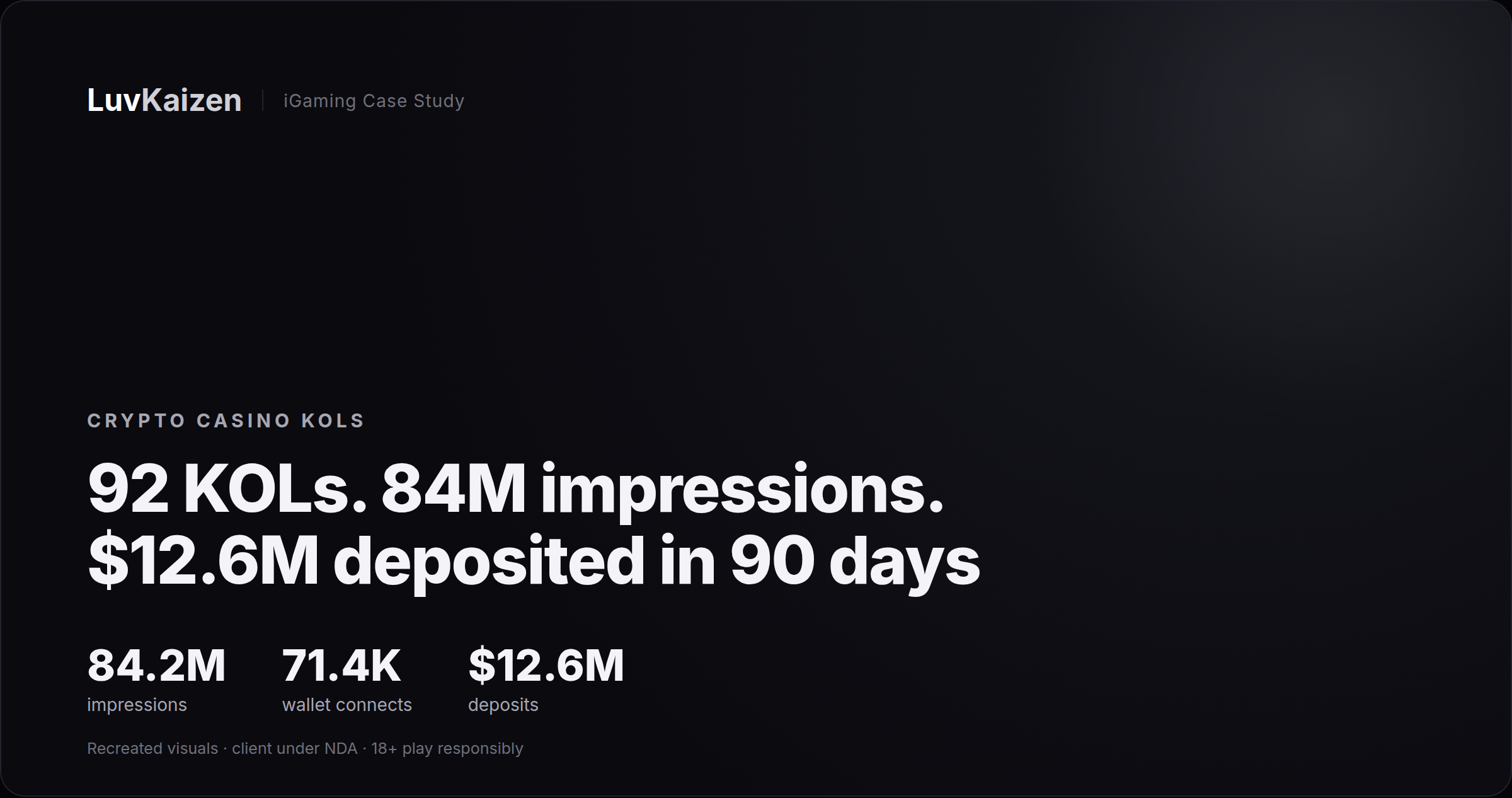
Quick answer: Marketing a crypto casino in 2026 requires a stacked playbook: KOL and streamer partnerships, iGaming SEO, UGC and clipping, affiliate programs, and community building on Telegram and Discord. Because major ad platforms block casino promotion, operators rely on these organic channels and use on-chain attribution to tie content to deposits.
Crypto casinos operate in a marketing environment that would be unrecognizable to traditional iGaming operators. Facebook will not run your ads. Google restricts your keywords. Most affiliate networks refuse gambling crypto offers. And the audience you are trying to reach is simultaneously the most digitally savvy and the most skeptical of traditional marketing in any consumer vertical.
Yet crypto casinos are among the fastest-growing segments in online gambling. The total crypto gambling market surpassed $90 billion in annual wagering volume in 2025, and projections for 2026 suggest another 25-30% growth. Players are drawn to instant withdrawals, provably fair games, anonymity, and lower house edges enabled by blockchain infrastructure. The opportunity is enormous. The challenge is reaching these players through channels that actually work.
This playbook is designed for crypto casino operators and marketing directors who need a structured approach to acquisition and retention. We will cover the full channel mix, compliance navigation, crypto-native audience behavior, attribution frameworks (including on-chain tracking), and a replicable campaign structure that has driven measurable results for operators in this space since 2019.
Understanding the Crypto Casino Audience
Before building a marketing strategy, you need to understand who you are marketing to. Crypto casino players are not a monolithic group. They break into distinct segments with different motivations, behaviors, and channel preferences.
Crypto-native gamblers are users who came to crypto first and discovered gambling second. They live on Crypto Twitter (now Crypto X), follow KOLs, participate in Discord communities, and evaluate casinos on technical merits: provably fair verification, smart contract transparency, token utility, and withdrawal speed. They are deeply skeptical of traditional marketing and respond almost exclusively to peer recommendations and community validation. This segment represents roughly 35-40% of the crypto casino market.
Traditional gamblers who adopted crypto came to gambling first and use crypto as a payment method for its speed, privacy, or because they are in jurisdictions where fiat gambling options are limited. They care less about blockchain technology and more about game selection, bonuses, and user experience. They are reachable through more conventional iGaming marketing channels but require messaging that bridges the crypto-fiat divide. This group accounts for approximately 30-35% of the market.
Degens and high-frequency traders overlap heavily with the crypto gambling audience. They view high-risk gambling as an extension of their trading behavior. They are active on Telegram, Discord, and X. They respond to high-stakes content, jackpot stories, and VIP programs. They tend to have high deposit values but volatile retention patterns. This segment is roughly 15-20% of the market but disproportionately valuable in revenue terms.
Casual crypto holders have crypto wallets but are not deeply embedded in crypto culture. They might try a crypto casino because they have idle ETH or SOL and the sign-up process is frictionless (no KYC for small amounts). They need more education-oriented marketing and respond to ease-of-use messaging. This is the fastest-growing segment, estimated at 15-20% and expanding.
Each segment requires different channels, messaging, and conversion paths. A one-size-fits-all marketing approach will underperform against competitors who segment and target precisely.
The Channel Mix: What Works for Crypto Casinos
The effective marketing channel mix for a crypto casino in 2026 looks fundamentally different from traditional iGaming. Here is how each channel performs and where to allocate budget.
KOL (Key Opinion Leader) marketing is the single most effective acquisition channel for crypto casinos, responsible for 30-50% of new depositor volume for operators who execute it well. Crypto KOLs on X, YouTube, and Twitch carry enormous influence with their audiences because trust is concentrated in individuals rather than institutions in the crypto ecosystem. A single endorsement from a mid-tier crypto KOL (50K-200K followers) can drive 500-2,000 registrations in 48 hours. The key is selecting KOLs whose audience overlaps with your target player segment, not just chasing follower counts.
SEO is the most cost-effective channel at scale but requires 6-12 months of investment before significant returns. Target keywords like "best crypto casino," "Bitcoin casino no KYC," and "provably fair slots" alongside long-tail queries specific to your differentiators. Crypto casino SEO is less competitive than traditional iGaming SEO, meaning a well-executed content strategy can achieve page-one rankings faster. Expect organic to contribute 15-25% of FTDs once the program matures.
UGC (User-Generated Content) and clipping fill the gap left by paid advertising restrictions. Creator-produced gameplay videos, win compilations, and review content distributed across TikTok, YouTube Shorts, and Instagram Reels generate awareness and trust without triggering platform ad policies. Invest in a network of 20-50 creators producing 50-100 pieces of content per month for consistent pipeline.
Affiliate marketing in crypto is undergoing a structural shift. Traditional iGaming affiliate networks often exclude crypto offers. The solution is building a proprietary affiliate program with on-chain tracking, transparent rev-share models (typically 25-40% for crypto), and crypto-native commission payments. Affiliate contributes 15-25% of FTDs for operators with mature programs.
Community building through Discord, Telegram, and X is not optional. It is infrastructure. A strong community serves as your retention engine, your word-of-mouth amplifier, and your first line of product feedback. Operators with active communities of 10,000+ members see 20-30% higher retention rates than those relying solely on acquisition marketing.
Navigating Compliance in Crypto Casino Marketing
Compliance is the constraint that shapes every marketing decision for a crypto casino. Get it wrong and you face platform bans, regulatory fines, or worse. Get it right and compliance becomes a competitive advantage because most of your competitors are getting it wrong.
Platform-level restrictions are the most immediate challenge. X (formerly Twitter) allows crypto advertising but requires pre-approval and restricts gambling promotion in many jurisdictions. TikTok prohibits gambling content in its advertising policies but allows organic content that does not directly promote gambling services (a nuance that matters enormously for UGC strategy). YouTube demonetizes gambling content but does not remove it if it complies with community guidelines. Discord and Telegram have minimal content restrictions but will shut down channels that facilitate illegal gambling.
Jurisdictional compliance varies wildly. If you hold a Curacao license (the most common for crypto casinos), your marketing is largely unrestricted geographically but you must be careful not to explicitly target jurisdictions where online gambling is illegal. If you hold an MGA, UKGC, or other Tier 1 license, your marketing must comply with that regulator's advertising standards, which typically include mandatory responsible gambling messaging, restrictions on targeting minors, and prohibitions on misleading bonus claims.
KOL disclosure requirements are tightening globally. The FTC in the US, the ASA in the UK, and equivalent bodies across Europe require clear disclosure of paid partnerships. Ensure every KOL partnership includes contractual requirements for disclosure (#ad, #sponsored, or platform-native disclosure tools). Beyond legal compliance, transparent disclosure actually improves conversion because crypto-native audiences punish hidden sponsorships when they are discovered.
Build a compliance playbook that covers: approved messaging guidelines for each channel, jurisdictional restriction lists (countries where you must not target users), KOL briefing templates with mandatory compliance language, and an approval workflow for all marketing content. This playbook should be a living document, updated quarterly as platform policies and regulations evolve.
The compliance advantage: operators who build robust compliance frameworks can move faster than competitors who operate in a gray area. You can scale KOL partnerships without fear of platform bans. You can invest in SEO content without worrying about regulatory takedowns. You build trust with players who increasingly evaluate operators on legitimacy signals. In a market where many competitors cut compliance corners, doing it right is a differentiator.
Attribution Challenges and On-Chain Tracking
Attribution in crypto casino marketing is harder than in traditional iGaming for two structural reasons: crypto-native users are more privacy-conscious (often using VPNs, multiple wallets, and rejecting cookies), and the decentralized infrastructure makes traditional tracking pixel-based attribution unreliable.
Traditional attribution breaks down in several ways. Users who discover your casino through a KOL on X may visit directly by typing your URL, bypassing any UTM tracking. Discord and Telegram referrals are notoriously difficult to track because link clicks in these apps often strip referral parameters. Crypto-native users frequently use privacy browsers (Brave) or VPNs that interfere with cookie-based tracking.
On-chain attribution is the emerging solution. By assigning unique deposit wallet addresses to specific campaigns, channels, or KOLs, you can track deposits directly on the blockchain regardless of whether traditional web analytics captured the referral. When a user deposits to a campaign-specific wallet address, you know exactly which campaign drove that deposit. This method is immune to ad blockers, VPNs, and cookie restrictions.
Implementing on-chain tracking requires integration between your marketing platform and your blockchain payment infrastructure. Generate unique deposit addresses (or sub-addresses for Monero/privacy coins) for each tracked campaign. Map these addresses in your analytics system. When a deposit hits a tracked address, attribute it to the corresponding campaign. This gives you clean, verifiable attribution data that you can share with KOLs and affiliates.
Hybrid attribution models combine on-chain tracking with traditional web analytics. Use UTM parameters and referral codes for the portion of traffic that accepts cookies and follows tracked links. Layer on-chain deposit attribution for the portion that does not. Cross-reference the two data sets to build a more complete picture. Operators using hybrid models typically discover that their organic and KOL channels are 20-35% more effective than traditional analytics alone would suggest.
Attribution for community-driven growth (Discord, Telegram) requires creative solutions. Implement unique referral codes distributed within community channels. Track invitation chains to identify which community members are your most effective organic advocates. Gamify referrals with on-chain rewards (tokens, NFTs, or direct crypto bounties) to incentivize tracking compliance among your community.
Campaign Structure: A Replicable Framework
After running 200+ campaigns for crypto and iGaming clients since 2019, we have identified a campaign structure that consistently produces results. Here is the framework.
Phase 1: Foundation (Weeks 1-4). Audit your current positioning, competitive landscape, and channel performance. Define your target player segments. Build or update your compliance playbook. Set up attribution infrastructure (on-chain tracking, UTM frameworks, referral code systems). Establish baseline metrics: current FTDs by channel, cost per FTD, player LTV by acquisition source.
Phase 2: Channel Activation (Weeks 5-12). Launch 3-4 channels simultaneously rather than sequentially. A typical initial mix: 3-5 KOL partnerships (staggered launches for sustained visibility), SEO content production (8-12 articles targeting long-tail keywords), UGC creator onboarding (10-15 creators producing initial content batches), and community seeding (Discord/Telegram launch with founding member incentives). Run each channel for at least 8 weeks before making budget allocation decisions.
Phase 3: Optimization (Weeks 13-24). Analyze performance by channel and segment. Double down on channels producing the lowest cost per FTD. Cut or restructure underperforming channels. Expand KOL partnerships from 5 to 15-20. Scale UGC production to 50-100 pieces per month. Begin affiliate program recruitment. Implement A/B testing on landing pages and registration flows.
Phase 4: Scale (Month 7+). With validated channels and optimized unit economics, scale budget allocation to high-performing channels. Expand into secondary markets. Launch seasonal and event-driven campaigns (major sporting events, crypto market milestones). Build a content flywheel where SEO, UGC, and KOL content reinforce each other.
Budget allocation benchmarks for a crypto casino spending $50K-$200K per month on marketing: KOL 30-40%, SEO/Content 20-25%, UGC 15-20%, Community 10-15%, Affiliate 10-15%. These ratios shift as channels mature. SEO's share of spend should decrease over time as organic traffic compounds, while its share of results increases.
Community Building as a Growth Engine
In crypto, community is not a nice-to-have. It is the primary retention and word-of-mouth engine. The operators with the strongest communities consistently outperform competitors on lifetime value and organic growth.
Discord is the hub for most crypto casino communities. Structure your server with clear channels: general chat, game-specific channels (slots, table games, sports), promotions/bonuses, support, and a VIP section for high-value players. Staff it with moderators who are genuinely engaged (not just bot accounts). Run regular events: tournaments, challenges, giveaways, AMAs with your team. A well-run Discord with 5,000+ active members can generate 10-15% of your monthly FTDs through organic referrals.
Telegram serves a complementary role, particularly for announcement distribution and for audiences in markets where Telegram is the dominant messaging platform (CIS countries, parts of Southeast Asia). Use Telegram for real-time promotions, exclusive bonus codes, and breaking news about new game launches or features.
X (Twitter) is your public-facing community layer. Maintain an active presence with a mix of promotional content (20%), industry commentary (30%), community engagement (30%), and educational content (20%). Engage with crypto culture. Quote-tweet relevant KOLs. Participate in trending conversations. The operators who treat X as a broadcasting channel lose to those who treat it as a conversation.
Community-driven retention tactics that measurably reduce churn include: exclusive bonuses for community members, early access to new games or features, community-voted promotions (let members vote on the next deposit bonus), leaderboard competitions with crypto prizes, and transparent communication during downtime or issues. Players who feel ownership over a community churn at roughly half the rate of non-community players.
Measure community health with engagement rate (daily active users / total members), organic referral FTDs attributed to community channels, member retention (30-day and 90-day active rates), and sentiment analysis. A healthy community has a daily active rate of 15-25% and a 90-day retention rate above 40%.
Practical Takeaways: Crypto Casino Marketing Checklist
Audience & Positioning
- Target player segments defined with distinct messaging and channel strategies
- Competitive positioning identified (what makes your casino different)
- Player personas documented for each segment
Compliance
- Compliance playbook created covering all active channels
- KOL briefing templates include mandatory disclosure language
- Jurisdictional restriction list maintained and enforced
- All marketing content goes through approval workflow
Channels
- KOL pipeline built with 20+ vetted prospects across tiers
- SEO content calendar planned for 6 months ahead
- UGC creator network of 20+ active creators
- Affiliate program launched with on-chain tracking
- Discord/Telegram communities active with daily moderation
Attribution
- On-chain deposit tracking implemented for campaigns
- UTM framework standardized across all channels
- Hybrid attribution model combining on-chain and web analytics
- Monthly attribution accuracy audit conducted
Measurement
- Cost per FTD tracked by channel and segment
- Player LTV segmented by acquisition source
- Community health metrics tracked weekly
- Monthly marketing ROI report delivered to leadership
Conclusion
Marketing a crypto casino in 2026 requires a fundamentally different approach than traditional iGaming. The channels that work (KOL, UGC, community, organic) are not the channels most traditional marketers are trained on. The attribution challenges demand new infrastructure. The compliance landscape requires constant vigilance. And the audience expects a level of authenticity and transparency that renders conventional marketing playbooks ineffective.
The operators winning in this market are those who combine crypto-native understanding with disciplined marketing execution. They know which KOLs move deposits, not just impressions. They build communities that retain, not just attract. They track attribution on-chain because they know traditional analytics miss a third of their conversions. And they treat compliance as an accelerator, not a brake.
If you want a specialist partner for this vertical, casino and iGaming marketing agency 3betmedia.com runs creator, streamer and KOL campaigns built specifically for crypto casinos, sportsbooks and prediction markets.
LuvKaizen has been building crypto-native marketing programs since 2019, long before most agencies acknowledged crypto gambling as a category. With a network of 5,000+ KOLs, 3,000+ creators, and 200+ campaigns behind us, we have the infrastructure and the institutional knowledge to build a marketing program that delivers measurable player acquisition and retention. Talk to our team about building your crypto casino's growth engine.
Related reading
- Crypto Casino Marketing Strategies That Work in 2026
- Crypto Gambling Marketing: Navigating Compliance While Scaling Player Acquisition
- Crypto Sportsbook Marketing: Reaching Wallet-Ready Bettors
- iGaming Affiliate Marketing: The Operator's Revenue Share Playbook
- iGaming Community Building: Telegram, Discord & Reddit Playbook
- iGaming Content Marketing: SEO-Driven Player Acquisition Strategy
Other Blogs
How Much Do Crypto Ads Cost in 2026? CPMs and CPCs by Channel
Real crypto advertising rates by channel: ad networks, Google, X, Telegram, KOLs and clipping compared on cost per 1,000 views and per click.
read blog
Top Kick Streamers in 2026: The Most-Followed Channels Ranked
The most-followed Kick streamers in 2026, what they stream, why LatAm creators dominate the platform, and how brands actually get placements.
read blog
Clipping Agency Pricing in 2026: Rates, CPMs and Models Compared
Real clipping campaign costs in 2026: CPM ranges, pricing models compared, budget examples and the questions that expose overpriced clipping offers.
read blog
Streamer Clipping: How Streams Become Short-Form Reach
How streamer clipping works: the rights-to-verified-views pipeline, real economics for brands and clippers, compliance, and DIY vs managed programs.
read blog
Top Casino Streamers in 2026: Who Moves Audiences
Who the top casino streamers are in 2026, what each tier costs to sponsor, and how operators should pick partners beyond the biggest names.
read blog
How to Hire Casino Streamers: 2026 Operator's Guide
The operator's guide to hiring casino streamers: platforms, vetting, deal structures, rates from $500 to $50K+, and compliance rules by market.
read blog
How to Choose a Crypto Market Maker: 2026 Founder's Guide
Engagement models, contract KPIs, red flags and a 7-step checklist for picking a market maker before your token launch.
read blog
Casino VIP Programs: How to Build One That Keeps High Rollers
Tier design, host playbooks and offer economics: building a VIP program that protects the players who drive most of your GGR.
read blog
Casino Player Retention: The 2026 Guide to Keeping Depositors Active
Most casinos lose 60-80% of new depositors in 30 days. The metrics, flows and mechanics that fix it.
read blog
What Is a Telegram Casino? How They Work and How They Grow
Mini-app casinos, TON payments and one-tap deposits: how Telegram became gambling's fastest-growing surface.
read blog
How to Start a Crypto Casino in 2026: Licensing, Software, Costs and Growth
Licensing, software, payments, budgets and the launch plan: what it actually takes to start a crypto casino in 2026.
read blog
iGaming Affiliate Marketing and Influencer Promotion: How Operators Combine Both in 2026
Affiliates and influencers have merged into one deal market. How operators structure, track and price the hybrid channel in 2026.
read blog
Robinhood Chain vs Base vs Solana: Where to Launch in 2026
An honest comparison on audience, distribution, tooling, liquidity and cost, with a clear pick for each.
read blog
The Robinhood Chain KOL Marketing Playbook
Creator archetypes, vetting, briefing and launch sequencing for a chain most audiences have not added yet.
read blog
How to Launch a Token on Robinhood Chain (2026 Guide)
Step-by-step: network setup, bridging, contract verification, pools.trade mechanics and the launch marketing timeline.
read blog
Robinhood Chain Explained for Crypto Marketers
What Robinhood Chain is, who is actually on it, and how its retail audience changes your go-to-market.
read blog
What Is a Micro-Influencer? Tiers, Rates and How to Find Them in 2026
What actually counts as a micro-influencer, what they charge, and when 50 micros beat one macro name for reach and trust.
read blog
Kalshi Promo Code Guide: What Actually Exists in 2026
No universal Kalshi promo code exists. Here's what's real (referral credits), the scams targeting this search, and how to check today's actual offer.
read blog
Token Farming Explained: Airdrop Farmers, Points Meta and How Projects Fight Back
Token farmers industrialize airdrop hunting. How farming works, what it earns, and how projects design campaigns that survive it.
read blog
Polymarket Invite Codes and Referrals: What Actually Exists in 2026
What's real behind 'Polymarket invite code' searches: how prediction-market referral mechanics work, what to avoid, and what operators can learn.
read blog
What Is a UGC Creator? Meaning, Rates and How to Become One
UGC creators make branded content without needing an audience. What the job is, what it pays, how to start, and how brands should hire.
read blog
Clip Farming: What It Is, How It Works, and How Brands Use It
The complete guide to clip farming: what it means, how clippers industrialize short-form views, what it pays, and how brands harness it safely.
read blog
GEO vs SEO: What's the Difference and Which Do You Need?
Rankings vs citations: what actually differs between SEO and GEO, why they compound, and how to split budget between them in 2026.
read blog
iGaming Clipping Compliance: Licensed Markets, Disclosures and Age Rules
The compliance stack for gambling clip campaigns: where clips can run, what must appear on screen, and how to evidence it — before regulators ask.
read blog
Verified Views: How to Audit a Clipping Campaign for Bot Traffic
The fight in clipping has moved from reach to whose views are real. Here's the audit methodology we run — and invite clients to run on us.
read blog
How Much Does a Clipping Campaign Cost in 2026?
Real 2026 clipping price points across bounty platforms and managed agencies, what a wave includes, and how to budget by goal.
read blog
Whop Clipping and Content Rewards: The Complete 2026 Guide
What Whop clipping and content rewards actually are, what clippers earn, what brands really pay, and where the model breaks — explained for both sides.
read blog
iGaming Affiliate CPA Rates 2026: Benchmarks by Geo and Vertical
The 2026 CPA, RevShare and hybrid benchmarks operators actually sign, by geo tier and vertical, plus the levers that move your rate.
read blog
How to Attribute Clipping Views to FTDs (Without Click Paths)
Clips rarely carry clickable links. These are the four attribution methods that still tie views to first-time depositors, and how to contract them upfront.
read blog
Cost per FTD in iGaming: 2026 Benchmarks and Your CAC Ceiling
FTD benchmarks by channel, geo tier and vertical, plus the LTV method for deciding the most you can afford to pay for a depositor.
read blog
Clipping vs Affiliate CPA for iGaming: The Cost per FTD Math
Affiliates price the depositor. Clipping prices attention. Here's the honest math that converts clip views into cost per FTD, and when each channel wins.
read blog
iGaming Affiliate Marketing: The Operator's Revenue Share Playbook
The definitive operator's playbook for iGaming affiliate marketing, covering RevShare, CPA, and hybrid commission models, affiliate vetting, compliance frameworks, and scaling strategies for crypto casinos.
read blog
Crypto Gambling Marketing: Navigating Compliance While Scaling Player Acquisition
Navigate the complex compliance landscape of crypto gambling marketing across jurisdictions, from KOL disclosure rules and platform policies to building a compliance-first marketing operation that scales.
read blog
iGaming Content Marketing: SEO-Driven Player Acquisition Strategy
Build an iGaming content marketing strategy that drives organic player acquisition through keyword clustering, content funnels, ROI measurement, and scalable production.
read blog
Top 10 iGaming Marketing Trends 2026: AI, Clipping & Crypto-Native Acquisition
Discover the top 10 iGaming marketing trends shaping 2026, from AI-generated content and stream clipping operations to crypto-native acquisition and KOL-led campaigns driving operator growth.
read blog
Short-Form Video for iGaming: TikTok, Reels & Shorts Playbook 2026
The definitive 2026 playbook for iGaming short-form video covering TikTok, Reels, and Shorts strategies for casino and betting brands navigating restricted advertising markets.
read blog
Casino Influencer Compliance: Disclosure, Responsible Gambling & Platform Rules
Navigate casino influencer compliance with this comprehensive guide to disclosure requirements, responsible gambling messaging, platform rules, and audit processes.
read blog
Crypto Sportsbook Marketing: Reaching Wallet-Ready Bettors
Proven crypto sportsbook marketing strategies to reach wallet-ready bettors through KOL partnerships, Telegram and X distribution, live betting content, and on-chain promotions.
read blog
iGaming KOL Marketing: Finding, Vetting & Managing Casino Streamers
Learn how to find, vet, and manage casino streamers and KOLs across Twitch, Kick, YouTube, and X for measurable player acquisition with campaigns that deliver up to 11x ROI.
read blog
Casino UGC Marketing: Why Creator Content Wins in Regulated Markets
Discover why user-generated content outperforms paid ads for casino and sportsbook operators in regulated markets, and how to build a scalable UGC program with proper creator sourcing, compliance, and ROI measurement.
read blog
iGaming Community Building: Telegram, Discord & Reddit Playbook
Master iGaming community building on Telegram, Discord, and Reddit with proven strategies for player retention, engagement mechanics, and converting members to depositors.
read blog
The Rise of Sweepstakes Casinos: Marketing Strategy Guide for 2026
A comprehensive guide to sweepstakes casino marketing in 2026, covering social media strategies, influencer partnerships, SEO, community building, and paid acquisition tactics.
read blog
How Casino Brands Use Clipping to Replace Banned Ads With Organic Reach
Learn how casino brands use stream clipping to bypass ad bans and drive organic reach through scalable content operations, compliance frameworks, and multi-platform distribution.
read blog
Sports Betting Influencer Marketing: Beyond the Tipster Model
Move beyond tipster-only sports betting influencer strategies. Learn how lifestyle creators, match-day content, and multi-platform campaigns drive sustainable FTD growth.
read blog
iGaming SEO: The Complete 2026 Guide to Ranking Casino & Sportsbook Sites
Master iGaming SEO in 2026 with this comprehensive guide covering technical foundations, keyword strategy, content architecture, link building, and AI Overview optimization for casino and sportsbook sites.
read blog
Blockchain UGC Content Strategy: Making Technical Products Legible
How to build UGC for technically complex blockchain products, from creator archetypes to measurement tied to testnet activity.
read blog
Crypto UGC Agency vs Freelancers vs In-House: Real Costs Compared
Four production models priced honestly, including management hours and rework, with a decision framework by monthly asset volume.
read blog
How to Choose a Crypto UGC Agency in 2026
A nine-criteria evaluation framework, a weighted scorecard, and the sales-call answers that should end the conversation.
read blog
Crypto UGC Hooks That Convert: 12 Formats With Examples
Twelve proven crypto UGC hook formats with example script openings, funnel fit, failure modes, and a system for testing hooks and reading win rates.
read blog
The Web3 UGC Creator Program Playbook
How to stand up a crypto creator program inside a Web3 community: tiers, incentives, briefs, QA, payouts, anti-farming controls and a 30/60/90 day rollout.
read blog
Crypto KOL List 2026: How to Build One That Actually Converts
Most crypto KOL lists rank by follower count, which predicts almost nothing. Here are the seven fields that actually forecast whether a placement converts.
read blog
Crypto Media List 2026: Outlets, Tiers, Link Types and Turnaround
The crypto media list most PR providers will not show you: how outlets tier, what dofollow status is worth, and the five fields to demand before paying.
read blog
Crypto Guest Posting Sites: Where to Publish in 2026
The crypto guest posting landscape in 2026: which sites accept contributions, what placements cost, and how to build links that actually move rankings.
read blog
Best Crypto Subreddits to Follow in 2026
The crypto subreddits actually worth following in 2026 (news, trading, DeFi and dev communities), plus how to market on Reddit without getting banned.
read blog
Top Crypto Discord Servers to Join in 2026
The best crypto Discord servers in 2026 across trading, DeFi, NFT, developer and ecosystem communities, and what makes a server worth joining.
read blog
The TGE Checklist: What to Lock Before You Launch
The pre-launch checklist that separates TGEs that build a base from launches that spike and die.
read blog
TGE vs ICO vs IDO vs IEO: What's the Difference?
The four token launch models explained, and which one actually fits your project in 2026.
read blog
Crypto Newsletter Sponsorships: The 2026 Guide (Pricing, Top Letters, Playbook)
How to buy crypto newsletter sponsorships that convert: pricing benchmarks, list vetting, formats, and the multi-send playbook.
read blog
Crypto KOL Marketplace vs. Agency: Which Gets You Better ROI in 2026?
Self-serve KOL marketplace or managed agency? A practical comparison of cost, speed, vetting and ROI, and when hybrid wins.
read blog
How Much Does a Crypto Press Release Cost in 2026? (Real Pricing by Outlet)
Real 2026 pricing for crypto press releases: per outlet, per wire bundle, and per top-tier placement, plus the hidden fees nobody mentions.
read blog
Where to Submit a Crypto Press Release in 2026 (15+ Outlets & Wires Compared)
Every serious option for crypto press release submission in 2026 (top-tier media, newswires, aggregators) with pricing benchmarks and pickup expectations.
read blog
Crypto Link Building: How to Get Backlinks That Actually Rank (2026)
Quality crypto backlinks are scarce, which is why they work. Seven tactics that earn links editors actually give, plus the traps that get web3 sites penalized.
read blog
Best Crypto SEO Tools in 2026 (What We Actually Use)
From keyword research to AI-citation tracking: the SEO tool stack we use across 100+ web3 projects, with what each tool is actually good for.
read blog
IDO Marketing Guide 2026: How to Launch a Token Sale That Sells Out
The hype-only IDO model is dead. Here's the 2026 playbook: launchpad selection, alpha-group KOLs, whitelist gamification and a week-by-week timeline.
read blog
AEO & GEO for Crypto: How to Get Cited by ChatGPT, Perplexity & AI Overviews
Over half of Google queries now trigger AI Overviews. Here's how crypto projects get cited by ChatGPT, Perplexity and Gemini: the complete AEO/GEO playbook.
read blog
How to Market a Crypto Exchange in 2026: The Complete Playbook
Registrations are easy; funded accounts are the business. The full 2026 playbook for CEX and DEX user acquisition: channels, budgets and metrics.
read blog
How to Become a Crypto Marketer in 2026 (Salaries, Skills, Paths)
Salary bands, real skills, and the fastest path in, from a team that hires crypto marketers.
read blog
How to Get People to Buy Your Crypto: The 2026 Demand Playbook
Demand = narrative × distribution × trust. The honest playbook, step by step.
read blog
What Does a Crypto Marketing Agency Do? (And When to Hire One)
The services, the costs, the red flags, and when an agency beats in-house.
read blog
KOL Campaign Wallet Activation Benchmarks (2026)
What a KOL campaign actually produces in funded wallets: 2026 planning bands by product category, funnel math, attribution setup, and the three decisions the numbers drive.
read blog
Crypto Casino Marketing Strategies That Work in 2026
Eight crypto casino marketing strategies that actually work in 2026, with cost bands per channel and a plan for combining them at test, scale, and aggressive budgets.
read blog
Crypto KOL Rate Report 2026: Real Rates From a 5,000+ Creator Network
Real 2026 crypto KOL rates from 5,000+ creators and 200+ campaigns: per-tier pricing, platform premiums, exclusivity costs and what each budget actually buys.
read blog
Whop Clipping vs Managed Clipping: Which Should You Run?
Whop clipping bounties vs managed clipping campaigns: real rates, fraud risk, compliance, and a decision framework for crypto teams.
read blog
UGC Video Rates 2026
UGC video rates in 2026: marketplaces charge $25–120 per video, managed campaigns run $15K–$100K+. Rate tables, crypto premiums, and budget guides.
read blog
Top Prediction Market KOLs to Watch in 2026
The prediction market KOLs to know in 2026: Domer, French Whale, Swiss Tony, Gunther Eagleman, PredMTrader, plus the archetypes brands actually hire.
read blog
Top Crypto TikTok Influencers & Instagram Creators 2026
The 6 types of crypto TikTok influencers and Instagram creators that matter in 2026, typical rates by tier, and how to vet them before you pay.
read blog
Short Form Video ROI Benchmarks 2026
Short form video ROI benchmarks 2026: #1 ROI format for up to 77% of marketers, 200B+ daily Shorts views, $1–5 clipping CPMs. Every stat sourced.
read blog
MiCA Licensing Guide 2026: Licensed or Locked Out
MiCA licensing in 2026: who needs a CASP license, €50k–€150k capital, real costs, timelines, jurisdictions, and the 1 July grandfathering cutoff.
read blog
Kick Streamer Casino Sponsorships Guide
How Kick streamer sponsorships work in 2026: casino rates, deal structures, platform rules, picking streamers, and clipping streams for reach.
read blog
Kalshi Marketing Playbook: How a $22B Exchange Grew
Kalshi marketing teardown: $17.7M TV, celebrity ads, a CNBC data deal, $500-per-post affiliates. What worked, what regulators flagged, where KOLs fit.
read blog
How to Make Crypto Videos Go Viral
How to make crypto videos go viral: hooks, clipping distribution, and policy arbitrage. One 60-min AMA yields 40–60 clips. The 2026 playbook.
read blog
The Crypto Exchange KOL Playbook
How crypto exchange KOL programs work: Binance, Bybit, Bitget, MEXC and Gate numbers, CPA vs rev-share math, and what in-house programs miss.
read blog
Casino Influencer Marketing Cost
Casino influencer marketing cost in 2026: $500–$5K mid-size streamers, $10K–$50K+ top creators, $50–$250 CPA per FTD. Full rate tables and budget plans.
read blog
Crypto Marketing Agency vs In-House: Which Is Right?
Agency or in-house for crypto marketing? An honest cost/benefit breakdown.
read blog
12 Best Crypto Community Management Tools in 2026
The tools that keep crypto Telegram and Discord communities safe and active.
read blog
The Crypto Marketing KPIs That Actually Matter in 2026
The metrics that prove (or disprove) your crypto marketing is working.
read blog
Is Crypto KOL Marketing Worth It? (Honest 2026 Take)
An honest take on when crypto KOL marketing pays off, and when it doesn't.
read blog
DeFi Marketing Strategy: A 2026 Playbook
How to market DeFi to skeptical, yield-savvy users and grow TVL.
read blog
How to Make a Meme Coin Go Viral in 2026
The mechanics behind memecoins that actually go viral.
read blog
Meme Coin Marketing Strategy: A 2026 Framework
A repeatable framework for memecoin marketing that compounds.
read blog
How to Market a Crypto Presale in 2026 (Step-by-Step)
The step-by-step playbook to sell out a crypto presale.
read blog
Crypto Influencer Marketing ROI: How to Measure It
How to actually measure and improve KOL campaign ROI.
read blog
How to Find Crypto Influencers (and Vet Them) in 2026
How to find and vet crypto KOLs that actually drive results.
read blog
How to Grow a Crypto Community in 2026 (Telegram & Discord)
A practical guide to building an active crypto community that lasts.
read blog
8 Best Crypto Ad Networks in 2026 (Compared)
The top crypto ad networks compared for reach, formats and cost.
read blog
How to Advertise Crypto in 2026 (Networks & Rules)
Where and how to run crypto ads that don't get banned.
read blog
How to Get Listed on CoinGecko (2026 Guide)
Everything you need to get your token listed on CoinGecko.
read blog
How to Get Listed on CoinMarketCap (2026 Guide)
A step-by-step guide to getting your token listed on CoinMarketCap.
read blog
9 Crypto Marketing Trends to Watch in 2026
The crypto marketing trends defining 2026, and how to use them.
read blog
Crypto Marketing Plan: Free 2026 Template & Framework
A copy-and-use crypto marketing plan template with timeline and KPIs.
read blog
What Sets Us Apart
Strategic marketing solutions tailored for the decentralized future

Blockchain Marketing Expertise
We understand DeFi, NFTs, and crypto projects inside and out. We make your project more visible and get more people using it.

24/7 Community Management
We build active Web3 communities people want to join. We handle moderation and protect from scammers and spam.

Crypto Native PR & Media
We get your project featured in crypto publications and connect you with blockchain influencers who matter.

Data-Driven Growth Hacking
We use real blockchain data to improve your marketing. Just strategies that work based on actual numbers.

Comprehensive Web3 Services
We handle everything from token launches to Web3 branding to app promotion. One team for all marketing needs.

Proven Blockchain Success
We've helped over 100 Web3 projects grow since 2019, including DeFi protocols, NFT marketplaces, and Layer 2 solutions.
We’re thrilled to dive into your Web3 project and uncover how LuvKaizen can supercharge your growth!
Here’s the agenda for our call:
Intro and what is LuvKaizen
Project or/and whitepaper overview
Your core marketing goals
How the LuvKaizen process works
Any questions about Web3 marketing
We look forward to discussing how LuvKaizen can accelerate your Web3 project’s success and help you achieve your goals.
See you soon!
Oops! Something went wrong while submitting the form.